The Programmer’s Guide to Hating AI – Part 6: The Age of the Poser Programmer

Introduction

We can’t just throw code together until it appears to work; we must concern ourselves with the structure of code. Paradoxically, concerns for structure and “quality of code” are often the fastest ways of getting something to work. When programming is done well, such concerns minimize the need for the most frustrating part of programming: debugging; that is, good program structure during development can minimize the number of mistakes made and the time needed to search for such errors and remove them.

…It is very tempting to dash ahead, focusing on the parts of programming that… are concrete and immediately useful and to ignore the “softer”, more conceptual parts of the art of software development. However, good programmers and system designers know (often having learned it the hard way) that concerns about structure lie at the heart of good software and that ignoring structure leads to expensive messes. Without structure, you are (metaphorically speaking) building with mud bricks. It can be done, but you’ll never get to the tenth floor (classical mud bricks lack the structural strength for that). If you have the ambition to build something reasonably permanent or something large, you pay attention to matters of code structure and organization along the way, rather than having to come back and learn them after failures.

Bjarne Stroustrup – Programming: Principles and Practices Using C++ (Third Ed.)

In the last part, I analyzed the folly of programmers delegating coding. Now it’s time to wrap up the series with why programmers are interested in doing that in the first place.

“Learn to code” was a mistake.

Remember that? It was a popular retort in the late 10s, eventually becoming a sarcastic taunt aimed at recently laid off people by their adversaries. Somewhere in the last 15-20 years of so, the “hot career” that everyone wanted to get into because the day-to-day work was comfortable and it guaranteed good pay and job security became computer programming. It used to be professionally degreed and licensed fields, such as doctors and lawyers. But that requires not just going to years of expensive school (4 years of undergrad, usually 2 years for the professional degree, and often years of some kind of residency after that) but being a good enough student to make it through all the certifications. Ideally those filters are in place to properly remove the people who are simply not qualified to do the job (they aren’t “smart” enough, or able or willing to pay enough attention to detail, or memorize enough source material, etc.).

The whole point of making professionals do all of that is to filter out most candidates. Obviously everyone would love to make a doctor’s or lawyer’s salary for work that’s entirely in an office. That means it attracts lots and lots of people who only care about money and, to be honest, would like to be lazy and avoid any strenuous labor. So we decided we need to filter those people out, which ends up being the vast majority of people who try to enter the field, in order to prevent people from abusing the career. Unfortunately the real world isn’t so neat. School has gotten so absurdly expensive people are now questioning if doctors/lawyers are even financially secure (they may make >$200k/year but have to pay off enormous student loans for most of their working years), and people have increasingly noticed for decades that universities tend to produce a specific type of obedient walking encyclopedia (basically a “meat LLM”) rather than genuinely intelligent, capable and invested graduates. This can end up filtering out some of the best people, but especially filters in a lot of the kind you don’t want and crowds out the good ones.

And then there’s computer programming, which is unique in two ways. First, there is no hard requirement for school. There is no licensure, no professional degree (the closest thing is a bachelor’s degree in computer science) and a lot of HR departments at corporations only require some bachelor’s degree (or even a lesser college degree like an associate’s), if they have a hard requirement at all. A lot of them only require this for candidates with no professional experience, which sounds like a Catch 22 for people without degrees, but startups, paid internships, etc. are opportunities to gain professional experience without that requirement, and then once you have a couple years, whether you have a degree or not (and what it’s in) stops mattering.

Here I am, 15 years into a software engineering career, and I have a bachelor’s degree in physics. I took two courses from the computer science department and nearly flunked one of them (also, I had written code to mod video games for years and was trying to build a video game console emulator as a side project).

Second, it is a 100% desk job. Doctors and lawyers often have to do things that go beyond just sitting in their offices, working on documents and talking to people. But this is all programmers do. They just work at computers all day. This not only makes it the pinnacle of a cushy “white collar” job, it also means it can done entirely remotely, which led to programming jobs starting to go remote even before the COVID pandemic. The job is similar to other types of engineering in that way (all engineers just produce design documents), although engineers in other fields may need to go “on site” if their designs are driving manufacturing. But those fields have harder requirements for engineering degrees (which, unlike computer science, are not part of the Arts & Sciences schools at universities, you have to decide to enter the engineering school).

So computer programming is basically the only option for people who are either too old or don’t have the time or money to spare to go back to school and earn a new degree, and start making good money working 100% at a desk either in an office or more likely from home. Especially to anyone who doesn’t actually know what programmers do (there’s a reason it’s a high paying job), this sounds like a fantasy come true, so a lot of people who otherwise have absolutely no interest in computer science, programming or even computers at all, but just want this nice career, decided to enter the field… and the main filter to try to screen out unqualified or even fraudulent candidates is mostly technical interviews, which people have put considerable effort into gaming.

The problem is programming as a job is basically a full time job of solving complex logic puzzles and math problems. Does getting paid a lot to sit in front of a computer compared to working in service or construction sound nice? Well, what if I told you it’s going to be like you’re back in school, but your classes are 8 hours long, it’s all math class (no English or history or art, etc.), and you have people breathing down your neck to correctly solve it yesterday please? For most people I’ve met, who readily volunteer to me they hate math, I can assure you “this is the most comfy job ever, you’ll love it!” would be a Faustian deal worthy of a Twilight Zone episode that ends with them screaming, “NOOOOOO!!!!” as the twisted irony settles in.

In the 10s, an industry arose specifically to facilitate this career switch, in the form of “coding bootcamps”: short, intensive training programs for people with no background in coding to quickly get up to speed enough to perform at an entry level programming job. Unlike professions like doctors or lawyers, where concern with quality and correctness have consistently trumped concerns with quantity (healthcare and legal representation are famously expensive, often ruinously, so there’s a clear supply issue, but we’ve all decided opening up the field to shoddy practitioners to drop the price isn’t a good idea), there was a huge demand for more programmers, so quickly training a lot of people seemed like a good idea and the companies who employ programmers supported it. They were struggling to find people.

What’s going on now with “AI Programming”, which doesn’t mean programmers adding AI to their tool belts and pulling it out on occasion when a particular task calls for it, but rather a revolutionary overhaul of the field to something entirely new (to the point corporations whose executives have full blown AI psychosis are retitling their software developers, no longer calling them “engineers” or “developers” but some new word, to indicate everything they do is now completely changed) that involves no “programming” in the traditional sense (“coding”), is a completely inevitable and predictable consequence of this rush (or, if you’re less charitable, invasion) of warm bodies into the field of programming whose only reason to be there is to get paid highly to sit in front of a computer for 40 hours/week.

People have been noticing the degradation of the software development field for a long time, and this has led to throwing out the word “gatekeeping” as an attack on any attempt to defend against or reverse it. Well, I’m a gatekeeper. I’m sorry, but everyone shouldn’t be a professional programmer, and I think a pretty good litmus test for that is if someone so intensely hates coding that he will do literally anything (including build elaborate Rube Goldberg machines out of expensive and unreliable “AI agents”) to avoid doing it as much as possible. Someone who feels that way about coding making himself do it for a full time job sounds like torture. I don’t think I’m being “mean” by telling those guys, “hey man, I don’t think this job is well suited for you”. The issue is they don’t have any other career options, and that’s the real problem that’s becoming a crisis in our society. Ironically, the “AI Revolution” would solve that, so it’s quite unfortunate that revolution is fake.

AI Programming Is the Latest Version of “Code Quality Doesn’t Matter”

When AI programmers are confronted about the quality of code that chatbot-driven coding produces, on rare occasion they will insist chatbots write high quality code that outdoes anything human programmers could do. The things are just geniuses. But more importantly, however good the code they write today is, it will be even better in six months (“just one more model, bro”). I remember one of them said something like, “just wait until AI is writing code more optimized than John Carmack’s Doom engine code”. So this is just AI cultists who think AI is God the App and it’s going to “wake up” any day and tell us all the secrets of the universe. They never present any examples or explain why they think this is true, it’s just the same “AI is AI, it’s magical and will just keep getting better” psychosis as “it’s going to replace all office work and usher in a post-scarcity utopia, unless it’s the bad kind and it turns us all into paperclips”.

The much more common response is rather: “okay maybe it writes sloppy code, but have you seen the code humans write? It’s a bunch of slop too!” That argumentative strategy tells us everything we need to know. Contained within it is two implications:

  • Either all, or the vast majority, of computer programmers write low quality slop code
  • It doesn’t matter and isn’t a problem that most code is low quality slop

The first point is curious because whenever someone argues this, you should ask them: does that include you? Their answer either has to be “yes, therefore I’m an incompetent programmer”, or “no, I’m a very special and rare talent that rises above almost everyone else”. Neither one of these are a claim they’re probably excited to make out loud and stick to. The second one is at least reasonable but it requires evidence, and we all know the irony of Dunning-Kruger that everyone thinks they’re a rare genius, but if everyone thinks that, obviously it’s not a rare belief, so the vast majority of them must be delusional about themselves.

The mostly likely reply you’ll get from an AI coder is the first: “yes I’m incompetent”. They have this really weird tendency to denigrate themselves in order to praise the AI God. When they show you some completely wrong, useless pile of slop the chatbot blurted out and you tell them it’s wrong and useless, they will reflexively reply with, “well that’s my fault for not knowing how to prompt it better!” (as Pivot to AI‘s logo says, “it can’t be that stupid, you must be prompting it wrong”), as if the whole point of their existence is to lower themselves at the feet of AI and say “I’m not worthy”. In case you still don’t think this is some kind of weird religion…

But the first point isn’t the important part. It’s the second point. If switching from human coding to AI coding is merely preserving the low code quality but doing it faster or cheaper, then apparently code quality doesn’t matter, or at best it matters but is less of a concern than being fast and cheap, and that implies that code quality is independent of how quickly and cheaply development work can be done.

AI coders are coders who believe code quality isn’t what determines the speed, cost and efficiency of managing a software product.

They readily admit chatbots are not somehow solving the low code quality problem (which they concede is not only a problem but a ubiquitous problem), at best they are sidestepping it by removing the humans who are the only ones slowed down by low quality code. This is the critical point we need to understand: AI coders think improving code quality is either not a priority or actively distracting and a waste of time.

This is not new (how often do I say that!). A subset of people who either do programming professionally, as part of open source projects, or as a hobby in personal projects, have always believed that code quality is an irrelevant distraction and burden on programming that just slows it down and overcomplicates it. They like to say things like, “just make it work” or “it doesn’t matter how pretty it is”. If they believed this in 2022, they still believe it in 2026 and love that AI has finally and officially freed us from ever having to talk or worry about code quality, which it does by making “coding dead” and then “code reviewing dead”. You can’t possibly worry about code quality if you’re never even glancing at the code!

(As I explained in the last part, no that’s not true, the problem of quality and design just reemerges in the “agentic coding” artifacts that people do write and review themselves, i.e. the prompts, skill files, spec files, etc.)

The point is this isn’t something that AI caused. AI just revealed or (since it was already revealed to those of us in the field paying attention to it) amplified it. The programmers arguing that code quality doesn’t matter have had to debate programmers like me who argue the opposite this whole time, and since they haven’t changed our minds, they do what salespeople always do and “throw mud at the wall and see what sticks”, just trying every possible avenue that leads to the foregone conclusion to see if we find that one persuasive. So when AI showed up, this just provided a new avenue to argue this point. They already believed the conclusion, they just see this as hopefully an opportunity to get those of us who don’t believe it to either start believing it, or at least shut up about it.

Also, they now have product departments and executives backing them, which has given them confidence to argue against more senior and lead engineers knowing they have the grace of the people who are all the engineers’ bosses. This didn’t change their minds about anything, it just made them louder and bolder. And it created a feedback loop where product people/executives latched onto these types of programmers, who told them what they want to hear (that maintenance and long-term investment into software isn’t a thing, and being ultra-shortsighted and shoving in features as fast as possible to max out next quarter earnings is actually the best way to do run a sustainable business… in this way it’s just continuing what Agile Inc. consultants started), and then went onto LinkedIn or to conferences and repeated it, and further emboldened programmers who already felt that way to start being louder.

Yes, Code Quality Does In Fact Matter

As I stated, I am one of the programmers these guys have to argue with. I couldn’t summarize my perspective on software engineering more succinctly than “code quality is everything”. I really shouldn’t have to argue this. I have heard some variation of the phrase, “the problem with programmers is they care too much about the code, when it’s the product that matters” more times than I can count. This is an astounding thing to utter and I don’t think I even fully appreciate how incredible it is.

Programmers saying “code quality doesn’t matter” is like:

  • Chefs saying recipe quality doesn’t matter
  • Home builders saying architecture doesn’t matter
  • Lawyers saying the accuracy of their legal case doesn’t matter
  • Doctors saying how carefully they listen to their patients doesn’t matter

“All that matters is that it works” is a thought-terminating cliche. It’s an empty tautology, because “matters” and “works” are essentially synonyms. Yeah, sure, the goal of making things is to make things that do what the thing is supposed to do. You understand there is no insight in that whatsoever, right? It’s like saying the Law of Identity (A is A) like it’s some kind of profound bombshell revelation about the world.

If a chef uses bad recipes, his food will suck. It won’t “work”. If home builders use bad architectural designs, their homes will suck. They won’t “work”. If lawyers make cases with bad arguments, they will lose cases. It won’t “work”. If doctors don’t listen to their patients, they’ll miss symptom details and misdiagnose them (and then mistreat them). It won’t “work”.

If you write low quality code, your software will suck. Software is rapidly iterative and incrementally modified, so that very often takes the form of “you got the first iteration out the door, but now you can’t increment on it”. “Works” in software doesn’t mean you delivered version 1.0. Your work isn’t done at that point. And when it comes time to deliver version 1.1, you have to go back into the code you wrote for version 1.0, and suddenly it matters not just that version 1.0 code satisfies the requirements of version 1.0, but that it can be easily and safely modified to satisfy the new requirements for version 1.1. So “works” is not the same thing as “satisfies today’s requirements”.

The belief that code quality doesn’t matter is plainly absurd to anyone who has worked enough in this industry to see what’s going on. I have worked for several large corporations who own large, old (10-20 years) gigantic piles of low quality spaghetti code, and the low quality of that code is a constant source of anxiety and frustration at every one of these companies (I mean for the business guys, not the coders). They all have growing backlogs of bugs that keep coming back (“regressions”). They regularly schedule “bug bashes” where they halt all forward progress on the system for a period to have the entire (meaning dozens to hundreds of programmers) organization do nothing but try to fix these bugs. This always backfires.

The attempts to rapidly fix a bunch of bugs inevitably causes more bugs, and the backlog of bugs ends up larger after every “bug bash”. Feature work proceeds at a snail’s pace. It’s very difficult to make changes (“adding a button will take a month”), and very risky because it will probably introduce a lot more bugs. Companies hire expensive consultants specifically to deal with low code quality and teach the organization how to deal with it. Even if said consultants are incompetent and just make it worse, the fact an attempt was made at all to deal with it tells you the business takes it very seriously.

In fact, what a lot of these big companies are doing is trying to rewrite their flagship products from scratch. Why would you do this!? Why would you waste so much time and effort recreating what you already have!? The answer is because the business is sick of trying to do any work on the systems they have and want to just wave away all the tech debt they’ve accumulated. They get further misled by rewrites because they proceed very quickly and smoothly at the beginning, encouraging the belief that this is just how things will be in the rewritten product once it is production ready.

They don’t understand that it was their corporate culture and practices that caused such a drop in quality in the first place, and since the rewrite is expensive to develop, serves zero customers (and thus makes zero revenue) and will not serve any until it reaches “parity”, it is very urgent to get it to parity, so guess what? It gets rushed! Developers are pushed to do things as fast as possible, under even more pressure than they were under the first time they did it. The result is an even worse product with even lower quality as it starts to approach parity, and once the reality that work on this product is even slower and more unstable than the live one becomes clear, the most likely fate is for it to be cancelled, making the entire effort a waste of time. Even worse, if they try releasing it to a few customers, they still realize it will never replace the original product, but they don’t want to cut off those customers so now they have to maintain both! And since they deliberately didn’t reuse any code from the original system (that would be polluting the new thing with all that old tech debt), they have two copies of all their business logic to try to keep in sync!

Software companies being either unable or unwilling to produce decent quality code is not “fine”. The fact it’s what most of them have been doing for decades (i.e. that it is normal) is not the same as it being okay. Yes, it’s normal. Low quality code is the typical case. And so is everyone inside these companies running around like chickens with their heads cut off, talking about how things are “on fire” all the time, wishcasting ridiculous deadlines without involving engineers at all (because they know what the engineers will tell them), and blowing massive amounts of money on attempts (that usually fail) to do something about it.

In fact, and this is the ultimate irony here, the reason why software executives are so obsessed with AI is because they think that’s their magic wand to wave this all away. The narrative being presented inside of software companies that are “embracing AI” and insist it’s “the future” isn’t some super-optimistic vision about making ultra-fancy futuristic software that people will be amazed by. No, the narrative is what we’ve been doing isn’t working and we need to change. I’ve even heard, direct quote, “the human software development lifecycle doesn’t work”. The reason they want the chatbots so badly to save them is because they have something to be saved from. Their businesses are slowly failing, they’re losing customers, it’s too expensive to keep their systems alive, much less do active development on them, and this is all because the quality of their codebases is so bad!

So if adopting AI coding is going to do nothing to solve the quality issue but just speed up the pace at which low quality code (i.e. tech debt) is produced, it’s just going to accelerate the decline of these systems! I believe this is the most likely fate of companies who do this for too long. They will throw chatbots at their legacy slop codebases, which will ensloppify them so much more that they become unusably unstable. Whether that makes all the customers leave or not depends on the competition, and the competitors are probably all doing the same right now, but SaaS is always competing with Excel spreadsheets, so it’s a matter of whether all the options get so bad it’s genuinely worse than just doing it all with Excel (hopefully Excel isn’t being ensloppified too).

To whatever extent these products are still going when everyone wakes up from this bender with a throbbing headache, the need for highly skilled “AI slop cleanup” programming shops will skyrocket. The best way to make it obvious how important code quality is, is for everyone to ruin the quality of their code to the point it causes a calamity, so… I guess there’s a silver lining to this.

The Equivocation of Passion and Vanity

By repeating the “what matters is it works” empty tautology every time they get into this debate, these guys are implying people like me who argue code quality does matter don’t care about software working. They’re arguing we care about something else. They think our fixation on code quality is an aesthetic indulgence or fetish, like we just open code editors and stare at “high quality” code, getting some kind of thrill or titillation out of just looking at it, and all code quality does is tickle our fancies.

The accusation that programmers who care about code quality just have a “fetish” for “pretty” code is much more significant than I think people realize. They will even call the belief that code quality matters programmer vanity. They claim we’re just using code quality to congratulate ourselves for being so smart and talented at programming (and better than other programmers) instead of caring about the companies who employ us, their software products or the customers who use those software products. So, we’re just selfish, self-indulgent, arrogant weirdos with a sexual attraction to “pretty code” and we want to turn the profession of programming into a self-serving way to get paid to indulge our weird fetish and feel good about ourselves.

When you say all this out loud, it really begs the question: are these guys sure this isn’t just a silly, ignorant and rather unfair straw man? Because it sure sounds like it when it’s all laid out plainly.

This isn’t just about programming. This is a general characterization of passion as vanity. The equivocation of these two behavioral traits is astounding, and once you realize that’s what this is, it quickly follows that a more likely explanation is this is what impassive and disinterested people think of people with passion. The idea that people being passionate (highly motivated and enthusiastic) about doing certain types of work causes them to poorly execute that work (and instead get distracted with aspects of it that don’t matter) is very bizarre. It’s like saying Isaac Newton being so weirdly obsessed with physics he was thinking about gravity while sitting under an apple tree relaxing would cause him to never reach any genuine insights in physics and instead just write a bunch of pretty equations down, stare at them and touch himself.

No, most of us understand the people who get that weirdly enthusiastic about things the rest of us consider to be tedious schoolwork we couldn’t wait to get done with are exactly the ones you want to pay to just sit around and follow that passion all day, because they’re the most likely ones to discover the next breakthrough. And also, that making the people who find the subject uninspiring, uninteresting and a chore to work on are not likely to do good work in the area. They are rather likely to just phone it in and do the least amount of work to check the box and free themselves of having to be further burdened by it (since, after all, they consider working on it to be a burden).

I mean, does the idea that some nerd can’t sleep at night because he’s stuck on the math problem he’s trying to solve and can’t let go of it because he’s so passionately obsessed with math thwarts his ability to eventually solve that problem, compared to the guy who “hates math” and couldn’t be happier to be out of school and never have to do it again, really make sense to anyone? Is this really what people are trying to argue, here?

To whatever extent programmers who really do enjoy and get obsessed with the craft of software development get some kind of emotional satisfaction out of authoring high quality, well-designed code, this is a consequence of their passion for the work. But why are they passionate about it? Or rather, what exactly are they passionate about? Why does “high quality” code tickle their fancy but “low quality” code doesn’t? They derive satisfaction from code being “high quality” because high quality code is valuable. It does the job, it accomplishes what software development seeks to accomplish, which is build working software, so effectively. It is this feature of code, so effectively and powerfully doing its job, that provides the “beauty” programmers find so desirable.

Math nerds don’t think wrong proofs are “beautiful” because the symbols are arranged in highly patterned ways. Whatever “beauty” might emerge from the patterns suddenly and completely disappears if it’s incorrect. And the reason why a succinct and patterned proof is more “beautiful” than a convoluted and meandering one is because it expresses the underlying truth more directly and thoroughly. It is never about viewing the positions or shapes of symbols as graphically pleasing like it’s a painting or something. That might be what people who “don’t get” being passionate about math think it is, but that’s only because they don’t get it.

Also, it is a blatant mischaracterization of passionate nerds to say they’re vain and just doing it to market themselves as smart and talented. This is exactly what I would expect people who LARP as passionate nerds to say as a “confession as accusation”: that’s what they’re doing by pretending to be passionate nerds, so they assume everyone else presenting an outward appearance of passionate nerddom must be doing the same. No, my friend, you underestimate just how weird passionate nerds really are. They’re not insecure people who just want to be popular and respected (a basic and widely shared human condition that “normal” people all understand and experience) and figured pretending to be passionate about technical fields is a way to achieve that. They really are, genuinely in the bottom of their hearts, obsessed with the thing. Math nerds are actually obsessed with math and think about it all the time. They’re not thinking about what you think of them all the time. They really, truly are thinking about math while they’re standing alone at the party sipping a drink. Yes, they’re that weird.

They aren’t staying up until 2am working on a problem so they can tell you about it later and make you think “wow, that guy’s really passionate about stuff, that makes him interesting”. It isn’t vanity. Yes, people who are very vain will LARP as passionate nerds, so now we have a problem of a bunch of imposters warping the perception of what passion even is, but that’s a problem because it warps the perception. Passion is about the thing you’re passionate about, not you. If it was always about you and not the thing, that was never passion, it was vanity. These are not only different, they’re almost opposites. We might say vanity is self-passion (being obsessed with and enthusiastic about one’s own reputation or value as a human being), which means it is specifically not a passion about things outside oneself.

The fact software company executives have been harassing (in many cases explicitly threatening to chase out, although I don’t think they really follow up on these threats) the subset of programmers on their payroll who are passionately obsessed with coding and lie awake at night thinking about how to improve the design of their products’ codebases to let it go, stop caring and just prompt chatbots all day is so bizarrely self-defeating. I can’t imagine a more incompetent attitude for an executive to hold. This is like a restaurant telling the head chef who’s passionate about cooking to get lost, or a movie director telling the artists who love drawing and were doing it as 8 year olds and have a bunch of side projects they do in their free time to get lost.

The comments on YouTube videos about what’s happening in programming have been filled all through 2026 with depressed coders talking not about how they were fired, they’re still employed, but they have been forced to stop investing into their work and just phone it in with chatbots instead, and this makes their job boring and unfulfilling (the term they’ve coined for what they now are is “meat proxy”). Congratulations, tech executives! Not only have you destroyed the talent pipeline for your own industry for years to come, you’re killing the passion in your most enthusiastic employees who actually got obsessed with your products and don’t just come in, move JIRA tickets around and take your money. I couldn’t sabotage a software company more effectively if you paid me an executive’s salary to try.

This equivocation of passion with vanity is about as reliable as an indicator of LARPing I can think of. Anyone who argues this either has no passions and doesn’t understand what it means to have one, or (more likely I think) he is a vain person who can’t imagine why people would exhibit behaviors for any reason except for self-congratulation. This is evident from the fact people who argue this are doing so (and this is certainly the case with the loudest AI boosters) in an attempt to sell themselves as better in some way, usually as more productive and efficient (i.e. “10x productivity”) than all those self-obsessed people who just like staring at their own creations.

This is a problem in programming because so many people joined the profession for no other reason than to make money, so they’re practically commanded to LARP as people who care about programming and what it takes to do it well. They don’t actually care about any of that, they just want to take the paycheck and go home, but they can’t say that out loud because then they destroy their own career prospects. They have to pretend to care, and this takes the form of arguing “caring actually means not caring and just half-assing all the work, since quality isn’t even really a thing here”.

“Code quality doesn’t matter, just make it work” is the calling card of the poser programmer. It is the confession that they don’t care about their craft, they’re checked out and just want to put in the minimum effort to get paid. Turning the highly technical and cognitively demanding job of computer programming into babysitting chatbots is just the logical conclusion of what poser programmers have always been out to achieve: to be called programmers and get paid as programmers without ever doing any programming.

Does AI Programming Somehow Force Quality to Improve?

Some proponents of handing the coding part of programming off to chatbots will pay lip service to code quality still being a concern. Funny enough, their argument usually works by badmouthing AI: basically chatbots are uncontrollable overpowered tools, like a machine gun with no mount but that fires so fast the recoil makes it impossible for someone to aim it, so the only thing you can do with it is “spray and pray”. On its own this is quite useless: such chatbots will write tons of code, some of it will be what you want, and much more of it will be what you don’t want.

But it can be made useful if you install a filter, usually in the form of an exhaustive suite of automated tests (see the graphic from the last part that shows how “testing” grows to replace “implementation”), but also if you robustly design a system with lots of compile time guardrails that will trip if something is broken. Then you can run a loop where the chatbot does something, it fails one of these tests, you discard it and feed the error back into the chatbot, and eventually it will converge to something that passes all the tests, and then you accept that. Since this is fully automated, the fact the chatbot has to make, who knows? 3? 10? 100 failed attempts before it finally succeeds is fine, because it’s still going to go faster than humans, can be parallelized, etc.

Well, that’s actually a terrible idea when you remember how expensive AI tokens are (all of the improvements in “coding harnesses” in 2025 and 2026 worked this way, the LLMs themselves peaked in early 2025, the harnesses try to define feedback loops like compiler errors, automated tests, analysis scripts, etc., and run operations in loops like this… it can work, pretty well if the guardrails really are robust, at the cost of an enormous amount of LLM inference). But regardless, the real question here is: how much effort would it take to write exhaustive automated tests for modern software (and I mean really exhaustive), and if you can do that, how much work would be left to implement it yourself?

I won’t get too into this here, but the short answer is: there is no such thing as exhaustive tests (especially once GUIs are involved, which the industry has widely decided are “not testable”, certainly not exhaustively) for modern software, so this is all moot. Whatever test suite you have, it definitely has gaps, and your “spray and pray” coding chatbot is going to very effectively find and exploit the gaps in it the same way they can “break out of” sandboxes and hack into other systems (brute force stochastic algorithms with megawatts of GPUs behind them always work this way).

But more importantly, I’ve also noticed the guys who argue this deal with the fact none of the large codebases they want to do this on have tests (or strong compile time guarantees) in the first place by using a chatbot to write all the tests! That makes the whole thing circular and pointless (the tests don’t have tests so you’re just spraying and praying the construction of your guardrails with no guardrails), but the fact writing tons of tests (which aren’t part of production code) is the strategy to make it work is still a concession the quality of the production code is going to tank. You can’t make the chatbot care about quality or architecture (you can try and beg it to care with skill files, but those are prompts, not guardrails), and the whole point of code quality is it’s a variation of code while holding the behavior it produces constant. The tests verify the behavior, not the quality. Installing guardrails in this way is a strategy specifically aimed at producing production code that is correct in terms of behavior as quickly as possible, with no concern whatsoever for its quality.

If you care about quality, you’re either going to have to write the code yourself (that’s literally what writing code means! It means thinking about and deciding what quality code is, and expressing that decision by writing it down), or describe the code you want so exactly (down to design and architectural details) to a chatbot that you’re using AI as an expensive and unreliable keyboard. There is no way to reconcile “I don’t write and don’t even read the code!” with “but the quality of that code is still important!”.

Conclusion

I don’t think people need to be programmers to be valuable as human beings or deserve to be paid high wages. That’s a bigger social problem we have to deal with: the growing class conflict between “blue” and “white” collar workers with an unjustifiable pay gap between them, that really boiled over during the COVID pandemic when most of the blue collar workers were either fired and left to starve while being told to not go outside, or told they’re “essential” and overworked while being exposed to what they were told was a virus so deadly it required shutting down society, and white collar workers sat at home getting food delivered to them and paid more than the people exposing themselves to the virus to be on their laptops. This created a huge amount of resentment that is now being expressed by gleeful excitement that knowledge workers are finally being torn down and humiliated by AI.

I empathize with people who became poser programmers. My intention is not to spread more resentment and ill will. Society puts way too much emphasis on intelligence as the most (only?) important measure of human worth (how fitting that it is now worshipping artificial intelligence) and this predictably encourages people to pretend to be highly intelligent. I have to deal with annoying people at work who make nonsense arguments about my craft and tell me the future of it is babysitting chatbots. But that’s a lot less of a tribulation than what a lot of people are dealing with these days (since the AI Revolution is fake, the economy is in poor shape and people are struggling to make ends meet). It would be absurd for me to call myself a victim of this and quite unhelpful to dress other people down with no attempt to understand their behavior. I can’t imagine having to pose as a programmer as a full time job is anything less than panic inducing, but apparently that’s less unpleasant than the alternative of working a different job.

My point is to commit to the truth. The wider social issues about financial insecurity, inequality and class conflicts are what is driving this, and we need to correctly understand that because degrading the meaning of software development down to the point anyone who doesn’t care about it and would hate to solve logic problems all day can do “it” isn’t going to solve any of those problems. Dismissing quality as a centrally important problem of all production and business is not helping anyone. We all work jobs and earn money so we can spend that money on goods and services. If everyone is phoning it in churning out low effort slop, we all suffer from it. This isn’t a world we should be helping to create.

The clear trend through 2026 is a growing disgust with AI among the public. This is hardly surprising. The experience most people have with AI is: as consumers it’s a gimmicky product that doesn’t really improve their lives, gets shoved into products they buy in unhelpful ways, and degrades the quality of things they buy by turning it into low effort slop, they’re forced to use it at work under threat of termination even if they think it doesn’t help, their bosses think it’s an excuse to compress deadlines and dump even more work on them with no extra pay, the news keeps telling them it’s going to take their job and career away entirely in just a short matter of time, and it’s powered by noisy, polluting and resource guzzling data centers that will ruin their local communities. Was this reaction really that hard to predict?

This is what committing to low quality, phoned in slop work gets you: it makes you a pariah. Don’t do it. Quality is what people want. Quality is what creates passion, which makes people enjoy their work. Quality is what gives a brand a good reputation and customer loyalty. Quality is what gives you long-term job security from a personal reputation of doing good work, even if one particular sweatshop fires you for not helping them churn out slop as fast as possible.

Quality is everything.
The Programmer’s Guide to Hating AI – Part 5: The Absurdity of “Coding Assistants”

Introduction

The virtue of formal texts is that their manipulations, in order to be legitimate, need to satisfy only a few simple rules; they are, when you come to think of it, an amazingly effective tool for ruling out all sorts of nonsense that, when we use our native tongues, are almost impossible to avoid.

E.W. Dijkstra – On the Foolishness of Natural Language Programming

In the previous part I went over the history of “coding is dead” movements and why, on a conceptual level, any attempt to remove or reduce coding from computer software is confused and doomed to fail.

In this part, I want to really dig into what using a “coding assistant”, or delegating the coding part of programming, does or even could really look like, and why it is, too, a confused concept that emerges from the confused base of coding being something that even could be eliminated or reduced from software development. This is, of course, about “AI Programming”, but that is just a specific manifestation of the general idea. Recall that I believe AI is computerized charlatanism, but even if I believed AI was closer to what it promises to be (a “genie in a laptop”), it wouldn’t change the fact that using it to “do the coding part for you” is a nonsensical idea.

Either you are the programmer (software engineer), and then it’s your job to carefully author code, or this software engineering role has been entirely delegated to the genie in the laptop, and then you are not an “AI Programmer”, you’re a product owner in an organization whose engineering department is a bunch of clankers. The latter is exactly what your product owners, managers and especially executives think is either already happening or just a few months away (after AI gets good enough and/or you finish building your robot replacement and then can be fired), but “AI Programmers” obviously don’t think their entire career prospects have gone up in smoke. They think their future is in this new “agentic engineering” role where they are still needed to do the software engineering part, but they just hand the coding part off to a sort of automated script. This is a schizophrenic concept. Sort of like “we can now create general purpose software without code” is “trying to have your cake and eat it too”, this idea of “AI programming” is a self-contradicting “foot both in and out the door” idea. Are you still a software engineer or not?

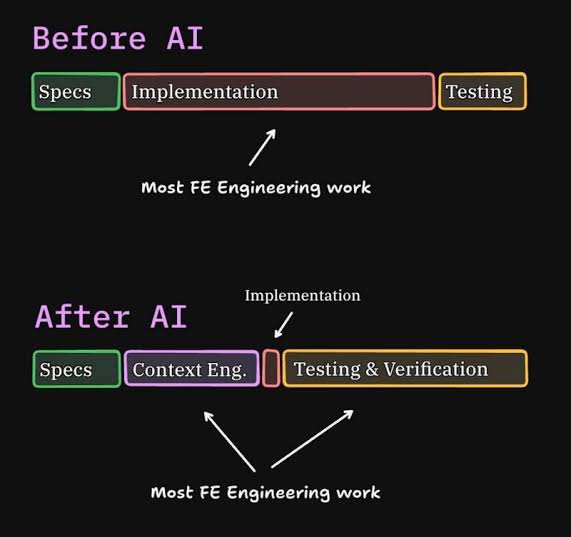
To be clear, since I believe generative AI is computerized charlatanism, I cannot even seriously entertain the idea that it will ever become a software engineer itself, so I’ve never even been slightly “worried” this is going to happen (what’s to “worry” about anyways, that we’re about to live in Star Trek replicator heaven?). Nothing that the software industry has wasted its time with in 2025 or 2026 even slightly suggests this is happening. The Rube Goldberg machines of “agentic software development” are rather desperate attempts to cancel out the bullsh*tting nature of token transformers and get them to act as some kind of generic scripting language, albeit one where you have to repeatedly explain to (as some people would describe it, beg) it to follow instructions. If you actually look at what programmers are doing here, you’ll see they’re writing tons of automated tests to try to “steer” the “agents” toward producing code that satisfies the requirements. You’ll see graphics illustrate this, e.g.:

Notice what’s the same?

This, amusingly, illustrates that AI literally made no difference. The length of the entire pipeline didn’t change at all, it just shifted the most time spent from writing mostly correct code to begging the chatbot to please write correct code (“context engineering”) and finding all the problems with the code it didn’t write correctly (“testing and verification”, which exists to begin with because there are mistakes in the execution of previous steps). This was probably not the intention of whoever created this graphic, but that makes it even funnier that it accidentally makes that point.

When you look at graphics like this, what you see is not people trying to make software development more efficient or productive, but rather people who work in software development but hate coding doing everything they can to minimize how much of their day-to-day job involves coding (this is very important and the subject of the next part of the series).

This kind of stuff is, indeed, nothing like AI being a genie in a laptop that can just take your request to build a software system and do all the engineering involved to build it. It’s engineers still doing the engineering but adding a bunch of complicated steps to the process.

This isn’t “coding is dead”. It’s still programmers typing instructions into their laptops all day, they’re just typing different instructions in different formats and languages. Coding is not dead, it is different, and so we need to have a conversation that I find very odd no one seems to have been having for the last year: is this new form of code actually better that the old form of code, and why?

Natural Language Is the Worst Choice for Code

What, in broad terms, is the difference between “AI/agentic” programming and “manual” programming? Referring to the “old fashioned” process as “manual” is already misleading, as if there is any less “on hands” process with AI than before. Like I said, programmers are still typing instructions on their keyboards into programs running on their development laptops just like they were before. This is no less “manual” than typing “code” directly was. Automation doesn’t necessarily make things less manual. We can imagine a machine that “automatically” performs a task, but the number of “manual” input steps required to prepare the machine to perform the task is actually greater than the number of “manual” steps needed to perform the task directly. The machine isn’t making it any easier, it’s just adding an unnecessary complication to the process.

The primary, though not only, difference, comes down to the language: “old fashioned” programming is writing instructions in a programming language like C, Java, C#, TypeScript, etc. AI/agentic programming is writing instructions in plain English, in the form of prompts and various additional artifacts that are consumed by coding harnesses that eventually become parts of prompts (AGENTS.md, skill files, spec files, etc.). These all have no structure except the rudimentary formatting provided by the markdown format. Unstructured English is, indeed, very different as a language for describing precise instructions for software than industry programming languages…

…and in every possible way it is worse for this task. In fact plain, unstructured natural language is just about as bad of a choice for writing precise instructions as you could possibly make. It is worse than machine code.

To understand why, you can start by reading the above-quoted piece by Dijkstra, On the Foolishness of Natural Language Programming. Dijkstra wrote this in 1978! So, once again, nothing is new under the sun, and if anyone thinks “we can finally make software by just talking in English!” is a new concept that has not been analyzed to death by computer scientists, they only confirm their ignorance of history.

Following an analogy he presents, imagine if we applied this same reasoning to algebra. Finally we can do algebra without using symbols! No + or =, no vertical stacks separated by bars (fractions), no parentheses, and certainly not letters like x to denote unknown values, instead we just describe equations in plain English! Doesn’t that sound great!?

Uhh… NO!!! No it does not sound great. It sounds downright awful, actually. Algebra would be nearly impossible without the symbols created specifically to efficiently and concisely express algebraic concepts. It’s not like these symbols were forced on us. Humans invented them specifically to avoid the tedium of talking about such things in natural language.

The big problem here is everyone outside the engineering department (who otherwise loves to talk about the technical details of computer programming), and a depressingly high number of people inside the engineering department, have no understanding of why programming languages work the way they do. They think programming languages are some kind of compromise we made with computers to converse in a way that’s kind-of nice for both us and the computer but not ideal for either. So they think finally unlocking the ability to talk to computers (including for the purpose of describing software to them) in our native languages is this big win that we’ve simply not had sufficient technology to achieve until now.

This is completely confused and backward in almost every way.

Parsing natural language is not some cognitively intractable problem that takes black box machine learning “don’t try to work out the algorithm, just tune it to a huge set of precomputed correct answers” techniques to crack. It’s not like computer vision (trying to reduce the construction of 3D scenery from pixels is such a problem, no one’s been able to crack the algorithm and they managed to sidestep this by just tuning a generic input/output function with known correct answers, a.k.a. “deep learning”). Languages have precise, well-defined grammars and dictionaries. This was problem was solved algorithmically, no “AI” required, decades ago. It’s how Microsoft Word was able to flag spelling mistakes in your document since the 80s, and grammatical mistakes since the 90s.

The problem is not syntactical but semantic, and this is not a technology problem, it is a problem with language itself. As I briefly discussed in the last part, natural language does not just express instructions. It expresses declarations about the world, emotions, wishes, predictions, questions, etc., and it supports vagueness, which it must, because thoughts, declarations, predictions, etc. are often vague and we need a way to communicate them faithfully. Natural language does much, much more than provide a way to express precise instructions, and the line between language that provides precise instructions and either provides vague, non-actionable instructions (clarification is required to make it actionable) or no instructions at all (it’s a poem or something) is very blurry and complicated to delineate.

A correctly functioning “compiler” or “interpreter” for natural language would reject anything that is not fully exact and exhaustive instructions as erroneous input, the same way a C compiler rejects a call to a function that doesn’t exist. The point is that we already built compilers that do this! The first major difference between high level programming languages and natural language is that they are highly constrained. The vast majority of valid English sentences are not valid Java statements. Syntactic minutiae like separating tokens by dots instead of spaces are irrelevant. The point is that the grammar of a language like Java is the subset of English that restricts it to exact and exhaustive instructions, rejecting anything else (declarations about the world, questions, exclamations, vague instructions, non-actionable instructions, instructions a computer system would not be able to perform, etc.) as syntactically invalid.

We’ve already done the work to carve out the subset of natural language that is valid for describing computer programs. They’re called programming languages.

Another type of input that a compiler/interpreter needs to reject as invalid input is instructions that violate the stated rules of the software system being built. These rules aren’t part of what needs to be executed by the program itself, they are rather a constraint on what executions the program should do. These rules can be rather sophisticated by themselves and need to, to some degree, be computed, making them a sort of metaprogram that needs to be executed whenever the actual program’s instructions are verified. These rules get intricately intertwined with the program’s actual instructions, so they need to both be referenced in the same documents (you can’t draw the distinction on a file/document level), which requires the distinction between them to be annotated with special syntax throughout the “source” documents. These annotations allow the program’s instructions to be “decorated” with information that is not an instruction per se (not one that should be performed when the program is running) and picked out by a static analysis tool.

The only way to make this type of analysis possible is to annotate the instructions in ways that indicate certain rules are known at design time. These annotations are added to programming languages to make static analysis (analysis by inspecting the source code instead of executing the instructions therein) possible, specifically a type of static analysis that the programmer can add his own rules to. The primary forms of this are function signatures (which indicate a certain symbol is a function, i.e. something that can be invoked, and usually indicate at least the number of arguments the function can be invoked with) and types, which ultimately determine what syntactically valid statements are semantically valid in the context of a program.

I have met a lot of programmers who think static typing is some kind of verbose burden dumped on programmers to be redundant in the instructions they write in code. Their favorite languages are ones like Ruby, which is explicitly designed to be as close to natural language as possible. This is totally confused. They don’t understand that the extra “fluff” in a language like Java or C# compared to Ruby is exactly why we have “Refactor -> Rename” tools in IDEs that work perfectly with absolutely no errors whatsoever in those languages, while if a comparable tool exists at all for a Ruby codebase, it’s guesswork that can’t formally distinguish calls to a specific method in a specific scope named doX from other callable symbols that happened to be named doX, including local or class scoped variables or an identically named method in another scope. Correspondingly, that refactor tool almost always does the wrong thing, and it is not possible to write a tool that does this operation correctly in Ruby.

Non-programmers and confused programmers will see all this “extra” stuff in code that wouldn’t be there, at least not as repetitively, if you were just talking in plain English, and think this is some kind of defect in such programming languages, or even worse something put in as a concession to make it easier for computers to understand it, at the expense of burdening programmers with more semantically empty “ceremony”. The latter is obviously not true because we have multiple programming languages like Ruby and Bash that don’t have these annotations. So computers being able to interpret such languages isn’t a problem. The requirement for such annotations in other languages is a deliberate design choice for those languages. We choose to make them work that way, for reasons that have nothing to do with helping computers understand them.

In fact, many such aspects of strongly and statically typed programming languages make writing the parser/compiler for them harder. In language design communities, people will often propose features for a programming language that enrich and complicate the rules for its type system or other annotations, that are pitched on the basis that they do something for programmers, they allow them to more robustly express rules that the compiler will then enforce at compile time (thus allowing larger classes of bugs to be rejected at compile time, preventing them from ever getting to even testers, let alone customers), but then get rejected because it’s too difficult to implement them in the compiler! That is, these language features make computers parsing and understanding the language harder. They aren’t compromises that push the language away from human-serving toward computer-serving.

Modern high-level programming languages have incredibly complicated compilers to make them work. These are some of the most complex and cognitively demanding programs that exist, far beyond the capabilities of most programmers (they would not be able to understand at all what the source code for these compilers are doing). We bent over backwards and put all this time and effort into building these compilers in order to serve programmers modern high-level programming languages. They have been designed for half a century specifically to serve the needs of programming, and are excellent at doing so. Anyone trying to avoid programming languages for writing software is like someone trying to avoid a car if they need to travel 30 miles down a road, and talking about how “I just traveled down the road without ever touching a steering wheel!” is some kind of win. What are you guys talking about!? These are the state-of-the-art tools made specifically for this problem!

This is not restricted to programming either, not by a long shot. Lawyers create restricted forms of natural language with which to write legal contracts (“legal jargon”). Every academic discipline invents terminology and often symbology (“academic jargon”) to efficiently and precisely express their ideas. No one talks about getting rid of this, so why are so many people talking about getting rid of programming languages in software?

AI is a Higher Level of Abstraction!

Using natural language to describe software is throwing away 60 years of progress in the fields of computer science, type theory, lambda calculus, formal grammar, and probably others I’m not thinking about. But curiously, AI Programmers claim exactly the opposite: that using AI is somehow just the next iteration in programming languages that moves us further away from machine code, in the same direction that existing programming languages already took us. They imagine a topology like this:

Machine Code -> Assembly -> BASIC/C -> Java/C#/TypeScript -> English

But everything I explained above indicates this makes no sense. There are of course many different programming languages in use today. There are OOP languages like Java/C#/TypeScript, but also Ruby and Python, which have always been more appealing to non-programmers (Python especially became the de facto standard for people who don’t want to get too much into programming to nevertheless write some programs). As I mentioned, the main design goal of Ruby is to be as close to natural language as possible (correspondingly its creator has successfully thwarted every attempt to add static typing to it, to the point it is now the last remaining industry language with no static typing, which PHP, JavaScript via TypeScript, and even Python now all have).

“AI is at a higher level of abstraction” seems to be a buzz phrase that probably originated from AI lab sales engineers marketing chatbots to tech executives. They know programmers talk about “abstraction” as being a good thing, so calling AI “the next level of abstraction” might convince a lot of programmers it’s the future of programming. I say this because I have not detected much real meaning in this phrase. I haven’t seen any concrete examples or elaborations on what this means, exactly. It seems to function primarily as a thought-terminating cliche.

It’s already questionable that OOP languages like Java/C# are at a “higher level of abstraction” than BASIC/C. C already has an essentially unlimited ability to raise the abstraction level. Abstraction means interfaces that express what to do without explaining how to do something. Any programming language that has functions can be used to build abstractions all the way up to the level of business specifications. This is possible in all of these languages, including C. The abstraction ceiling is not the difference between C and Java/C#. The difference is rather in what kind of conversation the programmer can have with the compiler, especially around design time constraints. This has more to do with verification of the program’s correctness, specifically at design (compile) time, than with building layers of abstraction that allow the business specifications to be written directly.

For example, Java/C# has classes that support inheritance, including abstract classes. You can build class hierarchies in C, and you can achieve the same level of conciseness (you don’t have to do it as a design pattern with boilerplate code templates) as long as you are willing to “build” the classes (lay out a struct with a pointer to a vtable that dispatches function calls through it) entirely at runtime and call their methods through strings and variadic parameters. You can support the concept of an abstract class that requires inheritors to override certain functions, and this will be enforced when you call the function to define a subclass. It will check if the base class is abstract, and if so, which functions need to be overridden, and if the subclass overrides them, which if it does not, will trigger an error.

The problem is this is all at runtime. There are performance problems with this (you’re spending CPU cycles and memory constructing all of this every time the program runs, even though it’s the same every time), but more importantly any mistakes, like creating circular class hierarchies, declaring overrides of functions that don’t exist in the base class or that aren’t marked as overridable, not overriding abstract functions, erroneous casting (like “sideways” casting across unrelated hierarchies, which is known statically to fail), or even calling non-existent methods, will all be runtime errors. They will be errors that occur while the program runs (triggering an abort or setting an error code that needs to be checked, etc.) and only when a line of code is actually encountered by the executing program. You built a class system with inheritance that the C compiler doesn’t understand. From its perspective it’s just a bunch of data structures and algorithms. So it can’t help you enforce that you’re following its rules.

If you do this in Java/C# with the tools the language gives you, the compiler does see what you are doing. The compiler understands the class, extends/inherits (or just : in the right position), overrides, virtual/final and abstract keywords. It recognizes those as special keywords with specific meaning, and it is able to check and enforce rules for using them correctly at compile time. If you make a mistake like circular inheritance, overriding something nonvirtual/final, or not overriding all the abstract methods of an abstract class, or casting across unrelated hierarchies, or calling a nonexistent method, the compiler flags it immediately and won’t even let you build your program until you fix it.

This isn’t about a missing ability to build as many abstractions as you want. Different languages have different levels of ability, and different techniques, to build concepts and rules at compile time instead of at runtime. It is the enhancement of the conversation you, the programmer, are able to have with the compiler (the thing that parses the language you’re writing in), that distinguishes different high-level languages (BASIC and C are both high-level) from each other.

And guess what natural language, including the prompts and markdown files AI programmers write, doesn’t have at all! That’s right: compilation, or any kind of static analysis pass that scans it all and detects errors. Even scripting languages do this when you first run them. The JavaScript interpreter will at least scan the entire script file immediately and reject it if there is a syntax error. You don’t even get this with the markdown files. You get no static analysis at all! And you can’t beyond basic “this isn’t even valid English grammar” or “this isn’t a real word”, because what enables static analysis is precisely the stuff that makes programming languages different than natural language. It’s those annoying syntax rules and annotations that enable static analysis that the people excited to never look at “code” again specifically want to get rid of.

So in the above sequence, English really belongs next to machine code. It’s a language with absolutely no static analysis whatsoever beyond basic syntax. Even assemblers will reject assembly that contains an invalid/unrecognized instruction or tries to CALL a nonexistent block. The total lack of static analysis that you just have to YOLO by executing it and hoping for the best is raw machine code (it’s just a bunch of bytes, every byte means something to the CPU so it’s going to do whatever that happens to be).

AI Is a Higher Level of Ambiguity

What I think people are vaguely trying to get at when they say “AI is the next level of abstraction” is this idea that with AI, now programmers can basically just be technical product owners. They can now just describe the business requirements/specifications in their prompts and markdown files, and the AI will act as a “library” that “implements” those requirements, the way programmers used to have to do themselves. This idea completely misconstrues why business requirements in JIRA tickets have never constituted the source code of computer software. It’s not because they’re “too high-level” or “too abstract”.

Plain English is not a higher level of abstraction, it is a higher level of ambiguity

An in the discussions I have witnessed, it is clear that a lot of programmers don’t understand the difference between abstraction and ambiguity, which is very unfortunate. “Abstraction” really is a buzzword a lot of programmers have been trained to blurt out whenever they want to defend something as good.

When you write array.sort() instead of writing all the lines that implement a sorting algorithm, you are not introducing any ambiguity into the program. It is still precise what is going to happen, and what the final state of the array is going to be. It is more abstract to simply say “sort” instead of explain how to sort. It is not ambiguous.

What people call “business requirements”, the acceptance criteria, etc., are almost always highly ambiguous. They do not explain exactly what the software should do. They leave out a lot of details… not implementation details (which product owners usually erroneously call them), but user-facing details that are part of what the software does, not how it does it. Product owners often use “implementation details” to mean “things I don’t care about”, but those are different. “Whatever, you pick something” is not the same as “do this, exactly this, but I don’t care how“.

If you try to put those vague, ambiguous requirements that are missing tons of critical details into source code files and hit the Build button, it will fail, the compiler will reject it as erroneous input, even if you put it in proper syntax for the language. But if you feed this into a chatbot prompt, it won’t say, “bro, there are so many missing details in this, you need to tell me exactly what you want for X, Y, Z, … before I can do this”, it will say, “sure thing, boss. I’m on it!” and then spit out… something, possibly something that you can then build and run.

If you think that is a good thing and encompasses the awesome power of AI, you could not be more wrong! It is not a good thing that chatbots invent missing requirements (and in fact requirements that weren’t missing, it’s just something the chatbot thought you’d like to be added) instead of tell you that requirements are missing and you need to fill them in. Being able to invent requirements if you ask it to is one thing. Inventing them automatically is another thing entirely. And if a chatbot ever takes vague, ambiguous business requirements in plain English and emits computer code from it, it is already guaranteed that it invented requirements not in those prompts because the input was vague, ambiguous and missing details, but the output is a computer program that runs and does something exact and fully detailed. The gap had to be filled in somehow (the way generative AI works is by filling in the gaps with whatever hopefully relevant examples were on the internet somewhere, i.e. filling in all the details for the layout and color template for websites, that aren’t in the prompts, with the default Tailwind black/purple style that every AI generated website uses).

Yes, human programmers can and frequently do this too. They take the vague, ambiguous requirements from product owners and fill in the gaps themselves with whatever they think the missing details should be. That’s almost always not good, and even when it is, it’s something you want a human to reason through, not a procedural generator to randomly grab examples off the internet for. We have put considerable effort into software development processes to catch and prevent this kind of requirements invention as early as possible, and force a feedback loop to bring in the stakeholders to properly address it. This is a large part of what BDD is intended to do: by having the stakeholder, engineer and tester collaborate (like literally be in a room together, it can be a virtual room) on authoring the specification, these missing details are shaken out early on, before any work begins that, if done based on misunderstandings, will lead to churn and waste, and placed properly in the hands of the stakeholder to be the decision maker (who can then delegate it if desired).

Finding problems, not least of which are missing or unclear details, in specifications for software as early as possible is a major part of what the software industry has been discussing for decades, all the way back to the original Royce Paper whose intentionally bad example of how not to run a software DLC was straw manned by Agile Inc. into “waterfall” (something they claim the software industry widely practiced before they showed up and saved the day). This counterexample was presented specifically because it lacked internal feedback loops that would detect mistakes and reverse the flow as soon as they were detected. The lack of such feedbacks meant that mistakes would propagate all the way toward final testing of a completed system, at which point they would be noticed and then they would have to be fixed, which is enormously expensive not just because of all the time wasted building the wrong thing, but because fixing problems like that is much harder in a finished system (the mistaken behavior may have become a “load-bearing column” of the overall architecture that can’t simply be removed or modified without significantly redesigning large parts of the system) than in a design phase.

Either way, even if we wanted to dump the responsibility of being the actual product owner (filling in all these requirements details) onto a chatbot, this has absolutely nothing to do with the chatbot writing code for you. It has nothing to do with prompts and markdown files being a better or more efficient language from programmers to work in. This would mean programmers feed the requirements they get from JIRA tickets into a prompt with the instruction to fill in the gaps and emit a better requirement, which the programmer would then formalize the syntax of to make it code, which should be far less work than explaining it to a chatbot and confirming it did so correctly. If there’s a large gap between requirements and code, the programmers need to build more abstractions.

You Don’t Have to Worry about Design Anymore!

Another idea is that delegating the “coding” takes the burden of “architecture” or “design” (as in code design, not graphic design) off of programmers and lets them “spend more time thinking about the problem”. I have heard ludicrous statements ranging from “now you don’t have to think about the right way to code a behavior” to “now you don’t have to waste time thinking about what to name every variable” in regard to this. I don’t know how people expect to be able to refer to a specific object in a system in the prompts in multiple places except by giving it a name, so I don’t know why they think prompting instead of “coding” somehow avoids the problem of thinking of names for things.

This one makes me the most upset of all, because this notion that architecture/design in code is some irrelevant artifact of programming languages or some other aspect of programming that any kind of “higher abstraction” tool can “unburden” us from is the quintessence of programmer incompetence. Like all of this, this is also not a new concept, and it’s one I’ve been fighting as hard as I can since I realized code design (or code “quality”) is everything a couple of years into my career.

Once again, this is exactly backward. How much “design” is there in machine code, in the sense of choices over how exactly to structure or lay out the code paths while keeping the user facing behavior the same? Well not none. For example, you can choose whether to code something as a loop (a jump instruction back to the start of a repeating section) or unroll it. You can inline sections into copies or write one version as a section that is jumped into and out of. You have to decide what algorithms and data structures to use. But overall… not much. How many books about “design patterns” are there for machine code, or assembly?

No, design or architecture is an aspect of programming that becomes increasingly important as we move away from machine code into high level languages, including from procedural languages like C to OOP languages. Design patterns are mostly associated with OOP, and mocking design patterns as excessive “over-engineering” is mostly aimed at Java. Java programmers are more burdened with how to design type/class systems (choosing composition or inheritance, for example), where to draw abstraction boundaries, how to make parts composable, and how to create only appropriate coupling and avoid inappropriate coupling, which is especially concerned with access scope (public, private, etc.), which are concepts introduced into high level languages that don’t mean anything once the program is compiled and running (from the machine or OS’s perspective, every part of a program has unfettered access to all parts of its memory). Ironically, this is frequently submitted as a major mark against OOP languages by C programmers, who think design patterns are just wasting time overcomplicating programs.

The idea that delegating coding to a chatbot (or anything else for that matter) suddenly makes such concerns not matter is a non sequitur unless you believe all of those concerns existed solely to make programmers reading code happy. This is a popular idea, as if there is something peculiar about humans that make design patterns important. The implication is that code design is some kind of aesthetic or emotional issue, which I will discuss in more detail in the next part of this series. But that is not why they emerged, and (this is the main subject of the Gang of Four “Design Patterns” book) spontaneously (through repeated independent reinvention) converged onto a standard set of ideas and techniques.

The purpose of design patterns in code is to organize and manage complexity.

Modern software is extremely complex, not in its “implementation details” but in its requirements or precise specifications. The ironic thing about claiming “programmers now get to be technical product owners” is (following the same pattern as all of this) that was always what they were! The lead engineers especially have always had the job of taking the vague specifications that only describe working software in people’s imaginations and adding all the details necessary to make it working software in reality. Again, this is not about “implementation details” (like choosing an array or a linked list, although even this has implications for user facing behavior through performance characteristics, which is the whole point of making a choice), it is about user facing details like how exactly a user interface is laid out and functions, what details (visible in the interface and often editable) exist in records and what rules they obey, and so on… things product owners rarely think of, but (at least the ones who actually do their jobs) once the lead engineer points out, they realize is missing details of the specification they need to decide on, or explicitly declare they don’t care about and let the engineer decide.

Here’s the thing that happens once all those precise, tiny details for all the intricate requirements get filled in: they become overwhelmingly complicated. All these specifications became an intractable pile of spaghetti that can’t be effectively incremented on (the key feature of software, which is rapid iteration or incremental modification) unless and until someone uses techniques to design the way those specifications are defined and expressed in order to keep them well organized and the complexity managed through abstraction/encapsulation (keeping complexity hidden from contexts where it isn’t important). This is what “code design” or “architecture” is and has always been about.

The tools to organize and manage that complexity, in ways that get statically analyzed and verified for internal consistency and conformance with constraints of the system being built, are a large part of what high level programming languages are designed to facilitate. When you take all of that away and try to specify software in English and not think about design concerns, you will get quickly overwhelmed with just how intricate and rich in complex features modern software is. If product owners think the well-designed and architected code expressing, exhaustively and precisely, all their requirements, is too much of a headache, just show them what the same expressed as a bunch of unorganized English prose looks like!

I’ve seen this exact problem come up multiple times when doing BDD and requirements analysis on enterprise software. Funny enough, the way product owners (remember that’s what we’re all supposed to be now, right?) deal with the overwhelming complexity of their business requirements is to literally avoid it by never writing it all down anywhere that even claims to be an organized, searchable source of truth for the software. Instead, most software these days is completely undocumented (except for the code itself), with the closest thing coming to an official ledger for its specifications being an unorganized history of JIRA tickets that would have to be collected and merged in order (since an older ticket can be superseded or even invalidated by a newer one) to be able to know what is the software supposed to do as of right now? By avoiding ever trying to build the official repository of requirements at all, product owners get to tell themselves that repository, if it were to exist, would be an easy read totally within their capabilities.

And then someone like me comes in and starts pushing them to actually do this by practicing BDD and requirements analysis, and almost every time, the reaction from product owners is to revolt against it, and specifically claim after taking one look at a proper set of specifications for even a small part of a system that this is code and not what they signed up for. In other words, they wan’t nothing to do with the full precise specifications for the product they “own”. I’m talking about Gherkin here, a sequence of plain English steps describing the initial conditions, action and final conditions of a single behavior in a system, no implementation details or algorithms anywhere to be found. That is what makes product owners throw their hands up and insist it’s not their job to worry about details on that level.

But even more interestingly, writing out Gherkin requirements for large systems becomes very tedious and hard to reason through because of the lack of design tools that full-blown programming languages give us. I realized after doing this a few times that “design patterns” are what we invoke to deal with this complexity, and that those product owners revolting against this sort of have a point: this isn’t their wheelhouse, it’s mine (software engineers’). What that means is: software engineers have always been primarily dealing with managing and expressing requirements. Especially in enterprise software where performance or other aspects that are sensitive to “how computers work” are lower in priority than getting all the intricate business logic correct, thinking about the requirements and how to express them in a way that keeps the complexity under control is already what we spend almost all our time doing, and it’s been that way for decades.

“Think about the problem” more? That’s how it’s always been… except for programmers who aren’t skilled in abstraction and design patterns so they really do waste most of their day writing repetitive boilerplate… but AI or some other “coding assistant” isn’t how you fix that, and in fact the last thing you’d ever want to do is hand novice programmers who work that way a tool that lets them generate this high entropy (little information for a lot of characters) code faster.

AI is the Next Compiler!

Somewhat related to the idea that “AI is a higher level of abstraction” that just continues the march from machine code to assembly to C to OOP languages, etc., there is this popular retort that “AI is the next compiler”, which is another way of saying natural language is the next programming language after modern industry languages. I have already addressed why this is completely backward. But comparing the AI coding workflow to a compiler specifically reveals some more major misunderstands of how the programming tools we use work, and why.

Besides working in a different language, what is the major difference between the way AI coders work, and the way “old fashioned” coders work? The answer emerges from the fact code is still the source of truth. The prompts and markdown files are not the official specification for the software system. The prompts are transient (they don’t even, generally, get saved anywhere, they go into a chat session, then that chat session closes and they are gone forever… and saving them wouldn’t be much help anyways) and the markdown files checked into the repo are, as far as the software system itself is concerned, irrelevant fluff. You can change those in any way you want, and it won’t make even a tiny difference to what the software does. If you want to change the software, you still have to modify the source code, which is still checked into the repo. But AI coders don’t write (and unfortunately for the ones suffering the most from AI psychosis, don’t even read) this source code. They only work on these transient and/or non-official documents.

There is no analogy between this and compilers.

There was never a point in history, however briefly, where programmers used compilers to write instructions, in a high-level language, for a modification to make to a software system, that is specified in machine code binaries, that would be executed by the compiler (the program that understands and executes the high-level language instructions) by reading in that machine code, performing the requested modifications to it, then writing it back, and then committing that modified machine code back to the repo. First, this wouldn’t work. The instructions to modify the machine code would have to reference things in the machine code (like variables, blocks of code, etc.), but those things have no representation in the high-level language, so how would they be referenced? Second, it would completely negate the value proposition of using high-level languages to begin with, which is precisely that they make the source of truth for the software system the high-level code.

Compilers shifted the code programmers work on entirely away from machine code to the high-level language. No version of the machine code needs to be maintained at all, because it is derivable from nothing but the high-level source code. The high-level code is not a series of instructions for modifications, it is the software, in its current form. Modifications to the system are made by modifying this code. The diffs from old to new can be reviewed, and tell a comprehensible story about what is being modified. If programmers ever tried to work in a way where they maintained a machine code binary, issued instructions on how to modify it, and didn’t even try to look at how the binary actually got modified and make sense of it (which, if they did, would mean they’d have to reason about machine code), they would lose control of the system they are working on, which might look fine until one day their modification tool stops working, and they realize they have a big pile of machine code no one wrote or has attempted to read or understand and suddenly try to comprehend it.

This would be a disaster that would end a software system abruptly. It would be literally unmaintainable. AI coders know this and defend what they’re doing on the completely baseless claim that AI will just always correctly modify the source code, with 100% reliability. They have no reason to believe this and submit no arguments for why this would be true, it’s just hand-wavy “but AI is AI, and it just keeps getting better!”, so then it must just do everything correctly, every time, or if it doesn’t, it will soon. In the entire lifecycle of a software system (which is supposed to be indefinitely), if AI screws this up just one time and can’t get dig itself out of the hole, guess what they’re going to have to do? They’ll have to send programmers into a giant pile of AI slop source code (which will easily be tens to hundreds of millions of lines, since AI can and does write tons of code really fast) that no one has ever even seen, try to make sense of it and fix problems with it. I can tell you exactly what is going to happen when this finally occurs, which by nature of probability is inevitable even if AI gets it right 99.9% of the time: no programmers will be able to fix it, the software will be literally unfixable, and it will have to be thrown away and restarted. There will be no other choice.

The belief that “AI will just be so good it will always handle it” is also born of ignorance of how generative AI (the transformer architecture) works. Frontier AI models currently have 1 million token context windows. The context window is a critical concept, because the way AI fakes “intelligence” is through its context window. Every single token (word or word fragment) an LLM generates in a reply is generated by feeding the entire conversation you’ve been having with it since opening the chat window (plus all the hidden static prompts the harness is decorating the conversation with) back into the neural net, which does a linear algebra transformation from this “vector” of tokens to the most likely “next token”. If it’s not in the context window, it simply doesn’t exist to the LLM. If you chop off the first half of the conversation from the context, the words the LLM will predict will be the ones that come next in a conversation that started in middle. This is when people notice LLMs acting “drunk”: they unknowingly blew past the context window (it went past 1 million tokens), so the early parts of the conversation (which probably contain critical context about what the conversation is about) get cut off, and the LLM completely “forgets” what it was talking to you about.

The context windows can’t just keep getting bigger, either. That’s a major part of the enormous cost of LLM inference, and it starts to rub up against the fuzzy “resolution” of the training data (which has also already been exhausted, the internet isn’t infinite).

1 million tokens (that’s roughly single words) is already much smaller than a lot of enterprise codebases, which often have more lines (comprised of many tokens) than this. An LLM literally can’t even pretend to “think” about these entire codebases. Humans can’t memorize millions of lines of code, but they do remember the important details. Code harnesses try to do this sort of “context compression” to simulate what humans do, but it’s just more fuzzy vector embedding guesswork. This presents an obvious reason why AI will not “just do this correctly”. It will not just flawlessly be able to make modifications to huge piles of AI slop code because those piles are much much larger than their context windows. They will start doing what programmers who can’t (or at least don’t bother to) be knowledgable in the system will do: just start monkey patching stuff, not realize it broke a bunch of far away things, and get stuck in an endless bug whack-a-mole loop.

And remember… all it takes is one time for AI to get stuck in this loop and be unable to get itself out (it will fix the bug it is pointed at, but cause 3 other critical bugs, and then when it fixes one of those, it will reintroduce the original bug), and your whole “agentically coded” software system is done, period, end of story. This isn’t unique to AI either. This is basically what’s happening, just more slowly, with most enterprise software already. The business is rushing everything, hiring a revolving door of cheap contractors who just shove tons of code into a system (rapidly growing the size to absurd levels, millions to tens of millions of lines for software that shouldn’t need more than a couple hundred thousand) until it gets stuck in a growing backlog of defects, with dedicated “bug bashes” attempting to address it just making it worse (the rushed bug fixes cause even more bugs). Most of them are in a state where only a small set of very highly skilled programmers who are experts in safe refactoring can salvage or work effectively (without making things worse) on these codebases. This is why so many of these companies are trying to rewrite their codebases from scratch, which is even less viable and almost never succeeds.

AI coding is just speedrunning this process of a software system collapsing into unmaintainability.

Now, what if eventually AI coders adopt a workflow that does make AI work like a compiler? That means they would stop checking source code into the repo, and stop writing prompts to make modifications. Instead, they would maintain a growing single prompt to “one shot” the entire software system: feed it into the chatbot, and the chatbot writes all the source code for it from nothing. It contains everything the software needs to do. This prompt gets checked into the repo, and is what gets maintained and modified in pull requests.

Well if that happens, then this prompt will become the extremely complex source of truth that needs to be managed and worked on effectively by humans. It’s definitely going to be much more than 1 million tokens, so the same context window issue is going to arise, and probably much sooner because describing software requirements in English is so verbose.

Then their workflow will be to modify this giant prompt in order to add or alter a feature. At this point, the workflow is identical to what it was before AI was involved, just substituting the source code for the prompt. And then the disaster of the software being specified in unstructured plain English will be fully manifest. Ironically, if any AI programmers attempt to do this (and probably before that, if this goes on long enough), the more clever ones will realize they keep making dumb mistakes in their prompts like typos that fail to convey two things are the same, or accidentally putting instructions in a section intended to describe the shape of data, or adding a parameter to an operation but forgetting to specify it everywhere it is invoked. And then they’ll come up with a brilliant idea: introduce keywords to annotate different parts of the prompt and write a parser that checks for mistakes like that before feeding it into the chatbot.

Congratulations! They just reinvented programming languages and compilers. Eventually one of them will realize that they’ve introduced so much formal structure into their prompt files, all for the purpose of helping them correctly write and modify their prompts, that the entire thing is parseable by a simple non-AI computer program and in fact can be directly turned into machine instructions. The parser that does static analysis is literally a language model, and once you have that, you don’t need large language models for all of natural language anymore, in fact involving one would be quite counterproductive. And at that point, they’ve squeezed the AI out of their development workflow and went full-circle back to what they were all doing in 2022.

Welcome to the Wonderful World of Metaprogramming

More experienced programmers who have done AI programming may object to all of this as irrelevant because they’ve seen AI just knock out tasks that would have taken them enormous effort to do “by hand”. This usually involves large scale refactoring operations. A popular example is translating a codebase from one language/tech stack to another. Chatbots don’t just magically do this perfectly. They claim to, and spit out a pile of code that is definitely not fully valid (and worse yet, in perfect alignment with the computerized charlatan trained to BS you, the ways in which it is not valid can be “cleverly” obscured and evade detection during a quick review, which is the only type of review possible because carefully reviewing a massive change set isn’t much easier than authoring it, especially for such “rote” work), but if you’re lucky, it takes care of a lot of the tedious parts of translating it, and you can then pick it up and fix all the issues with it.

A lot of the positive testimonials to programmers augmenting themselves with AI are some variation of this. They have some task they need to complete on a large codebase that is largely a bunch of mindless tedium (applying some kind of highly patterned change to a lot of code, which is an indication of poorly written high entropy code, but that’s the reality for a lot of enterprise systems), they already did the software engineering work of figuring out what design/architecture they want to get to, and they just want to hand the menial execution off to something else.

So here’s the thing about that. Programmers absolutely should not be wasting their valuable time and talent mindlessly typing repetitive patterned changes. But do they need AI to automate this tedium? Well… no! What they need is the skill of getting a computer to knock out a mindless, repetitive task quickly and flawlessly instead of doing it manually… which is always what computers have been for. You know what skill is called?

Computer Programming!

In other words… when a programmer realizes he needs to execute a loop of repetitive modifications to code (or to generate a lot of repetitive boilerplate code, which like I said, he usually shouldn’t be at all, unless the goal is to get the compiler to enforce a pattern of rules that the language doesn’t support expressing directly), instead of manually typing it all out, he should write a computer program to do that for him. Writing code to write or modify code is a concept nearly as old as programming itself. It’s what assemblers and compilers fundamentally are to begin with. And approaching programming tasks this way, with a mindset of reflexively applying the programming skill back on programming itself, is extremely under-appreciated and undernourished in the industry. I didn’t start doing metaprogramming until around 12 years or so into my professional career. I had thought about it for years but kept dismissing it as “too hard” or “not worth the trouble”, until I actually tried it out, and couldn’t help but laugh once I realized how much time I had wasted up until then.

The specific example where I did this was to write a program that takes an OpenAPI spec of a web service used by all the clients of a software system (mobile, smart TV, etc.) and generates the strongly typed client code to call it. This work of writing the “glue” code for a mobile app to consume the web service by hand constituted probably 30% or more of my time in the years I did mobile app development, and this wasn’t peculiar to me. It’s just how it’s done. But I had some downtime on a project and decided it would be an interesting experiment to try to hand this off to a utility program. The OpenAPI spec was available in YAML format, so I need to write a program that parses YAML, then loops through the structures describing the endpoints and shapes of request bodies and responses, and generate source code (Swift in this example) from it. How long did it take me to write this program and get it to fully generate working client code?

One day. One freaking day!

In one day, I accomplished what the rest of the client developers had to repeatedly spend a significant part of their effort on doing themselves (since the project was early on and the web service was still very volatile and incomplete) for the entire project. Every time I needed to implement a feature that needed a part of the web service newer than the last time I hit the “generate” button, I just hit it again, and in a couple seconds I had all the code I needed to call the service.

Roughly in parallel with this, I had also encountered a few cases of needing to translate an app from one language/stack to another. The first time I ever did that, I did it pretty manually. But this, more than anything else, forced me to start learning more about regular expressions (regex), which almost every IDE supports as a way to issue patterned find-replace operations. The next time I had to do this, I had reduced most of the tedious part to firing off a sequence of standard regex find-replace commands (to, for example, convert variable declarations in the form of Type name to name: Type, or replace function declarations of the form ReturnType functionName(...) with function functionName(...) -> ReturnType, etc.), leaving only the “interesting” parts of substantial differences in platform libraries that shouldn’t be handed off to a mindless algorithm for me to attend to.

Metaprogramming is a wonderful thing, especially when working on big, messy legacy codebases. The extent of what you can accomplish with it depends only on how seriously you want to invest in tooling for it (some tech stacks like .NET, which comes with a lossless parse tree tool, a part of the compiler Roslyn, to analyze and modify code in structured format, already have some). If you can parse source code into syntax trees and render it back to source code (what the aformentioned .NET tool does), it’s surprisingly easy to execute very sophisticated refactoring or patterned modification operations. Taking data in various formats (web service specs, database schemas, data structures in e.g. JSON, etc.) and rendering patterned code from it is quite simple (it’s just emitting lines of interpolated strings) and extremely powerful. Again, I’m surprised programmers (including me) don’t do this more. It’s probably downstream from software companies aggressively dissuading any amount of investment into tooling or maintenance and instead shouting at programmers to build the next feature right now.

Whatever you can accomplish with AI in this regard, you can accomplish it with traditional code and have it be much more reliable and cheaper. You will be able to precisely control what it does, it won’t fool you with convincing but subtly wrong outputs or randomly go off script and start doing things you don’t want, and you don’t have to write a check to Dario every time you execute it. The reason why programmers get impressed with AI in this area is because their own skills in that area are quite underdeveloped. They would be much better served developing those skills further than just telling a chatbot to do it and hoping it works out.

This is also true of scripting. There are various tedious little tasks programmers have to do routinely that aren’t writing software. Some programmers will tell you handing that stuff off to AI is a good way to utilize it. Sure, that makes a lot more sense than “agentic engineering” where you bend over backwards to create code without ever thinking about, writing or looking at code, but once again, scripting is just another programming skill.

Software Factory!?

The Final Boss of all the confused nonsense emerging out of the big rush to shove a chatbot into programming in a quest to “automate as much as possible” is the idea of a “dark factory” for software. It’s a fully autonomous system you just feed requirements into and software comes out the other end like a conveyer belt. I can attest from direct experience that software companies are spending significant time and money trying to build something like this. Like I said at the beginning, the intention the non-technical parts of the companies have in this is, once the factory is operational, to fire either the entire engineering department, or all but a skeleton crew to occasionally tighten screws on the factory as needed. I don’t know what the programmers working on this think is supposed to happen.

But the point is putting the two words “software” and “factory” next to each other succinctly captures how completely confused people have gotten about these concepts. Those two words are almost polar opposites, standing in complete contradiction to each other.

A factory is something that takes a blueprint and just churns out identical copies of the real thing the blueprint describes. For example, a factory might take a blueprint for a car engine, and produce engines according to that blueprint repeatedly. A factory operation is literally a loop, and in fact is built very similar to how computers (specifically CPUs) work: a pipeline that stages the operations, where each stage repeatedly loops on its specific job, taking inputs from the previous stage (or the blueprint if it’s the first stage) and producing the inputs for the next stage (or the output if it’s the final stage), which is exactly how CPUs loop over instructions of a program and execute them in stages.

What is “software”? It is literally a blueprint! It is a blueprint for what a computer should do. What would it mean for a “factory” to create software, or blueprints? It’s quite simple. We all have “software factories” at our finger tips. Here, do this: go find an .exe or .app or whatever file on your computer (whatever an application or program file type for your operating system), hit Ctrl+C and then Ctrl+V (or Cmd+C then Cmd+V). What just happened? There’s a copy of the file for the program. So now there are two copies of the app! You just manufactured a computer program from a blueprint!

Yes, a “software factory”, if it means anything at all, means copying and pasting.

But that’s obviously not what people have in mind. They think a “software factory” takes a… blueprint… for what, exactly? And then it… produces something repeatedly in a loop. That thing it produces isn’t a particular (already existing) computer program, it’s a new computer program, a .exe or .app that didn’t exist at all before the factory ran. And on every loop it produces new computer programs, each one being new and unique, just like each engine the car engine factory produces is a new and unique engine that can be put into a car.

But… every engine is exactly the same. That’s the whole point! That’s why the factory can run in a loop: because each iteration of its operation produces something identical. Each engine that it produces is “new” and “unique” in a physical sense, which is why it’s useful. It is, literally, implementing Ctrl+C -> Ctrl+V but for a physical thing like an engine. If I have two cars, I need two engines. If I have one, I can’t simultaneously put it in both of my cars. I would need to copy it, which means to take a blueprint or specification for the engine I already have and use it to drive a manufacturing process that produces another actual engine. With physical things, “factories” looping over this operation of producing identical real physical copies of an abstract concept is useful.

But a “software factory” is more like a factory that produces… engine blueprints? So it doesn’t churn out actual engines in a loop, it churns out pieces of paper (or USB sticks, or just saves a new file to a network drive or something?) containing the design for an engine. But if it’s a loop, it’s repeating, which means it’s producing the exact same design every time. So… it’s a file copy operation! Yeah, we already have that, and it works for all files ever (files are just bytes and computers can already copy bytes). The idea that each iteration produces a different design, a novel design for a new engine, like… on iteration 1 it produces the design for the next year’s sedan inline 4 cylinder engine, on iteration 2 it produces the design for the next year’s sedan high trim V6 engine, on iteration 3 it produces the design for the light truck V6 engine, on iteration 4 it produces the design for the medium truck diesel engine… this completely contradicts what a factory is, because it’s not a loop. It’s producing something completely different each time. Nothing is being “repeated” here.

And what would be the blueprint you feed into this “factory”? A blueprint for… making all the engines conceivable? Or… making an unspecified engine? But then you’d had to specify which engine you want, and then you’re feeding a series of specifications into the “factory”, and what would those specifications be except the blueprints for the engines? In other words, what do people imagine being fed into this “factory” on each iteration other than precisely what they want to come out of the “factory” on each iteration? And in that case, what is this “factory” doing (passing through a design document from one place to another)? You have to already design the blueprint to feed it in, so the factory certainly isn’t “building” the blueprint for you.

What do people imagine feeding this “software factory”? The answer is requirements for a specific software system, right? Well as I’ve been harping on this whole time, that’s the software! If you’ve done all the work to fully specify the system, then you already did all the work you’re expecting this “factory” to do. And again… what is the “blueprint” that drives this factory? A blueprint for… all software, ever? Well that’s called a computer (a general purpose mechanical device that can execute a set of instructions in a sequence, which means it can execute any computer program fed into it). But we’re not talking about hardware factories, so… there’s just nothing here. “Software factory” is an empty concept. “Factory” implies a repetitive loop turning a blueprint into identical real copies of a thing, and “software” is unique blueprints for instructing a computer to do something (which it can do as many times as you want, you can double click an .exe repeatedly).

The fact people ever started talking about “software factories” makes it blatant this is all just tech babble nonsense by software company executives and product people having fever dreams about making “all the money” while doing essentially nothing. It’s gone completely off the rails and we shouldn’t be indulging this (which we’re doing because a few AI labs full of weird cultists who think GPUs have feelings if they process natural language have a lot of money right now).

Conclusion

Programmers delegating “coding” to something else, whether it’s a chatbot, another type of computer program, another person, etc. is confused because “coding” means precisely instructing a computer to do something. You’re still doing that, but with unnecessary, unreliable and expensive extra steps crammed in. It’s really just throwing away the more than half-century of foundation we’ve built up for how to do that most effectively. There’s a reason we code in programming languages, not English.

In the final part of this series, I will discuss the issue of coders who hate coding and make it their mission in life to work as a professional “programmer” but do as little programming as they possibly can, which is a large part of why this has gone as far as it has.

The Programmer’s Guide to Hating AI – Part 4: A Brief History of “Coding Is Dead”

Introduction

Those who do not know history are doomed to repeat it.

In the previous parts of this series I have been addressing AI itself. Now I am going to start talking about how it has been targeting my field of software engineering. None of this is new. This is not the first time “coding is dead”, or even the first time AI in particular was going to kill coding.

An excellent review of this cycle of history is here. I encourage you to read this, it covers the timeline better than I ever could. What I want to do is highlight the most pertinent parts of the timeline, and give a somewhat different perspective on why this cycle keeps repeating, and especially why it keeps not working out the way it is supposed to. If you have read the previous parts of this series, you will know I do not agree with him that AI provides any significant productivity improvement to programmers or that it is a tool similar to high-level programming languages.

In that article the author discusses the issue of fixating on tools, which misunderstands what programming is really about: understanding. He also says that typing code has never been the “hard part” (or bottleneck), it is working out exactly what software is supposed to do, which is enormously complex, and becomes more complex the more tools emerge that simplify or abstract away low-level programming tasks. This is another manifestation of the Jevons Paradox: any tool that makes coding easier doesn’t shift the job of programmers down to a less cognitively demanding one, it shifts the complexity of computer programs up until the cognitive demand is back to what it originally was.

The point about fixating on tools is one that cannot be overstated. I have lost multiple job opportunities because the hiring manager believed I did not have enough years of experience in a specific language, framework or platform, despite the fact that my overall experience, both in programming in general and even in the relevant more specific domains (like frontend or mobile app development) were more than twice the job requirement (they missed a huge opportunity not hiring me). Almost every manager I have worked with believes my “skill set” is one of these things (a language like C#, Swift, etc., a framework like .NET, Ruby on Rails, etc., a platform like iOS, Windows, etc.), which is ironic because multiple such managers did not realize (due to the way I came into a job, such as through referral) my experience with the relevant tools was almost nonexistent.

It is from this misunderstanding of programming, which is analogous to viewing carpenters as having skills in “hammers” or “drills”, or novelists as having skills in word processors, or mathematicians having skills in drawing symbols, that people are now saying absurdities like that a programmer’s skills are now suddenly “obsolete”, because he will now use AI as his primary tool instead of those other things. Even if programmers shift entirely from programming with e.g. Visual Studio and C# to Cursor and prompts/skill files/etc., this is a trivial change to the job. Competently guiding an agent to produce acceptable code requires the exact same skill sets that programmers already had (or did not have), which are primarily about breaking high-level operations down into precise parts, ultimately down to algorithms, and managing the resulting very cognitively demanding complexity of all the required precise specifications. Programmers are the authors and maintainers of very elaborate, exhaustive and exact blueprints for information processing systems. Nothing has changed in this regard, even if we fully accept (which, remember, as I will get into, I do not) that AI is now the best tool available for programmers to perform this work.

He also specifically mentions that this is now the third time humanity finally figured out AI, it’s going to revolutionize everything, but first it’s going to eliminate computer programming. That happened in the mid 1960s, and then again in the mid 1980s. Well, the AI research community told everyone that’s what happened. What actually happened was that the thing people called AI that actually existed wasn’t anything like what AI researchers were promising, the false promises first hoodwinked a lot of people and then, once they realized they had been taken for a ride, they turned against not just the AI they had at the time but AI as a concept, and what followed was AI Winter: a large dry-up of public interest and funding for AI research. The author seems to suggest this time is different for AI. I don’t agree. I think the only thing different this time is the scale and sophistication of the magic trick, which only means when everyone turns on it this time (and especially after the enormous malinvestment into GPU supercomputers causes major economic damage), the winter that follows will be much more severe.

But the author of that piece does not dig into what I think is the most important part of why these promises to “eliminate coding” never worked out, which when we address, also reveals why AI is not an appropriate tool for code authorship at all, all the reasons given for why it is being based on gross misunderstandings of programming and programming tools.

The Original “Coding Is Dead”: COBOL

As stated in the article, “the story begins” with the first promise made to businesses that their businesspeople could now handle the creation and maintenance of their software directly, instead of hiring programmers to do this, thanks to a new tool created to enable businesspeople to specify software in terms they already understand. This tool was called Common Business-Oriented Language, or COBOL. This was a language based on English that could be understood and executed by computers, allowing the businesspeople to write the software specifications in familiar English terms and eliminate the need for programmers to manually translate those specifications to computer code.

Of course it did no such thing. COBOL didn’t eliminate programmers and allow business managers at banks to write and maintain the computer code for banking systems, it just created a new profession of COBOL programmers. But this should be “obvious” in hindsight. After all, COBOL is a programming language! Since when has creating new programming languages eliminated programmers (as in, the people who read, understand and write documents in programming languages)? The idea that something like COBOL would open up programming to non-programmers seems very strange. Did anyone think Java, or C for that matter, would do this? The problem, which we will discuss thoroughly later, is that people in these discussions have no coherent definition of “code”, or “programming”. This is why they don’t realize why business managers don’t want to touch COBOL with a 10 ft. pole any more than they wanted to touch assembly, or C, or any other computer code.

He goes on to say “COBOL succeeded spectacularly as a programming language”. That, I most emphatically do not agree with. “Success” here is measured only by how widely it was deployed… and even then, it really wasn’t successful. Almost no programmers ever touch COBOL today, and it has been that way for several decades. COBOL is widely used in mission critical parts of modern society, most importantly the banking system, but it is strictly quarantined in those areas, and every business that has to own such codebases has done backflips to minimize how much they have to touch them or expand them to new responsibilities. Banks usually have software systems written in Java or C# that handle all the newer stuff like their web applications and middleware, that call into the “core” COBOL system only to handle the transaction logic that they built decades ago.

The fact that this core of the banking system is still in COBOL is actually an expensive disaster. IBM has to continue manufacturing otherwise grossly obsolete mainframe computers, with old CPU architectures and instruction sets, just to allow these core codebases to continue to run without heavy, and risky, modification. Everyone is so terrified of making any modifications to this code, they don’t even want to update compilers to let it run on newer hardware. The vast majority of professional programmers today are not qualified to touch that code and banks won’t let them. This situation already became a disaster in the 90s, when people realized that code is full of a specific mistake: the Y2K problem (dates being represented as two-digit numbers that rolled over at the century). This required COBOL developers, most of whom had retired (again, most of the actively developed code for banks by this point was something like Java that just called into the COBOL core), to be brought out of retirement just to scramble to fix this problem before it started breaking the banking system.

This all begs the question of why banks didn’t just hire and train programmers in COBOL and build all of their systems, including the newer stuff, in COBOL. Marshalling calls between separate systems written in different languages is a significant architectural complexity added purely as a result of deciding to make the rest of the system separate and in a different language. Why did the industry pay for all this extra complexity, and in the process make maintenance of the COBOL core a niche speciality that requires rare and expensive (and increasingly unavailable as time goes on) talent, instead of just sticking with COBOL all the way?

The answer is precisely because COBOL is not a good programming language. The reason is obvious: it wasn’t made to be a good programming language. It is a programming language designed with the contradictory goal of not being a programming language, but instead being… something else, something that appeals to non-programmers. Programmers were explicitly not the target audience for COBOL, so it is not surprising that programmers don’t like it. Judged on the same basis as other programming languages like C or Java, COBOL is not appealing at all. It failed its promise to make business managers the programmers, and forced programmers to deal with code trying to obscure the fact it is code, which makes it harder to work on. There is a very important lesson in this: trying to replace programmers not only doesn’t work, it causes decades of expensive and difficult problems for any part of the industry that is seduced by the promise.

The Elusive “Fifth-Generation Language”

In the 80s, as programming languages were getting more advanced (object-oriented programming was starting to show up), people noticed that code written in these languages was more abstract, more declarative and less imperative, and read much more like the business specifications for software than exercises for computer science students compared to older code written in, say, C or BASIC. So naturally they imagined that one more round of advancement in programming languages would “raise the abstraction” all the way out of “programming” entirely, and again eliminate the need for a specialized “programmer” profession and instead allow the product owners, who create the specifications, to create the software directly.

The idea was that the move away from imperative and toward declarative programming would finally be “completed”, so that the text documents prescribing a software system were entire built out of constraints or rules without any spelling out of “how” a computer would perform calculations in line with those constraints or rules. The product owners are the ones who write the constraints or rules, so they could just write them directly in some kind of editor program that would generate executable code directly from those specifications.

My first professional job that involved any kind of “programming” used one of these languages: LabVIEW. I was an assistant at one of the laboratories at the physics department of my university, and they needed to add a thermostat to their lab setup. We added the necessary hardware, a thermometer and heater, to the setup, and connected them to the computer. Then I programmed a control loop that would keep the system at a specified target temperature using LabVIEW to describe the feedback loop that takes a difference in actual and desired temperature and calculates how high to set the heater. You do this by literally drawing circuits.

At the time this seemed fine. In retrospect, with 15 years of professional programming under my belt, I think it would have been much simpler to just write this program in C, or maybe Python. But I understand the point: most of the people working in the lab (students of the physics department, usually grad students) had little to no background in computer programming but occasionally needed some simple algorithms like this, but they all took multiple classes in electronic circuits (something every physicist needs to understand) so drawing circuits, and knowing what circuit to draw to implement a simple algorithm, was something they could handle.

These kinds of languages found niche applications like this. What they did not do is make any kind of impact on the software industry. The reason is basically the same as COBOL, just to a larger degree: these are tools explicitly targeting non-programmers, that may allow non-programmers to do some things they otherwise would not be able to do, but certainly did not allow non-programmers to start building advanced or complex computer software. You still need programmers for that, and if you know a programming language, it cannot be more obvious how silly it would be to try to use one of these “non-programming” tools to build software instead of just using a programming language. I mean, I shudder to imagine trying to draw a circuit that would implement even a basic calculator or todo list mobile app in LabVIEW.

The lesson here is that programming languages are by their nature general purpose, while “more abstract” specification tools achieve the higher level of abstraction as a tradeoff with less generality. What makes programming languages so… “programming language-y”, the characteristics everyone is so desperate to get rid of, is precisely their ability to express the requirements of any computer program. What non-programmers don’t like about programming languages aren’t mundane syntax features like braces or parentheses, it’s how complicated it is to spell out exactly how to do things. The only way to relieve people of that burden is to limit the scope of what they are specifying. This is basically what all productivity software is. You could write a C program that renders any word document you can think of… but C is so much more powerful than that, so this is sort of like killing a mosquito with a machine gun. The alternative is to use Microsoft Word. You can’t build an arbitrary computer program in Word, but you can render a word document by just describing the elements to render (text, images, etc.). What makes it easier (much easier in fact, I’m a professional programmer but I don’t want to write my word documents as computer programs) to create word documents is also what makes it impossible to create anything else.

The idea of a “general purpose computer program that lets you build programs” but that isn’t a programming language is “trying to have your cake and eat it too”. It is trying to achieve two contradictory goals simultaneously. In doing so you will either create another programming language (and probably not a great one, like COBOL) or you will create a tool that has a specialized use case but does not target computer software in general.

Visual Programming Languages, WordPress, etc.

The idea of a more abstracted editing tool for making software was also approached from a different angle. Software is almost always a GUI these days (and has been that way since at least the 90s, if not 80s), so a major part of building software is building the GUI. The GUI is designed by designers (graphical artists for computer software, who also work out how the user experience should work, i.e. what buttons do what, what elements to activate to navigate around, etc.). Programmers would build these GUIs in code, and wouldn’t even know what it “looks” like until they compile and run the program. Wouldn’t it be nice if you could build the graphical user interface of a program graphically? And then, since it’s designers who are really the ones building those interfaces, can we just cut the programmer out of this entirely?

This is an interesting one because as a professional programmers who’s worked mostly on frontend GUI systems, I would love it if this could actually be accomplished. I have always been frustrated by the significant overhead/waste of designers using their own software (Photoshop, or more recently something like Figma) to draw the GUI of the system I’m working on, only for me to have to take those drawings and redraw them myself in the programming tools I use (and then at the next demo get yelled at by the designer about how something is off by a pixel or has slightly the wrong color or gradient shape). I won’t talk about the ideas I have about how to do that because that’s a topic for another article. The point is: the software industry really tried to do this for a solid 20 years, it totally failed, and by now they have completely retreated.

This started in the 90s with “what you see is what you get” drag-and-drop GUI editors. NeXTSTEP, which eventually became Mac OS X, had Interface Builder (it was originally an entirely separate application from Project Builder, the code editor, before they were combined into Xcode, which strongly indicated the idea that different professionals would use each one). Microsoft had the “visual” programming languages (Visual Basic and Visual C++), whose respective identically named editing tools were eventually combined into “Visual Studio”. Java had Swing, with various vendors providing graphical editors. Web applications have always been strongly divided between code and GUI descriptions, owing to its history of emerging from simple HTML (the HTML itself is the data describing the GUI, adding code to web pages to turn them into applications required special <script> tags to be added to HTML).

These all got pushed hard in the 2000s and early 2010s, but by the mid-late 2010s, the trend had started to reverse. No one was using them according to their original intent. Designers weren’t opening up Interface Builder or Visual Studio, working on the GUI directly and saving their work back to the code repos. They didn’t want to go anywhere near those “programmer” tools or the code repos, which would have required training in version control systems. Instead, they used their own tools made just for designers (Photoshop, Figma, etc.) and delivered programmers mockups they then had to rebuild in these graphical editors. Programmers gradually got fed up with the graphical editors and started doing this directly in code, which is more expressive, and simpler because there’s no awkward boundary between data files or generated code and the code they had to work on directly anyways.

The tools eventually caught up with this in the late 2010s and early 2020s. For example on mobile, both iOS and Android pivoted to “next generation” reactive UI frameworks modeled after React (SwiftUI on iOS, Jetpack Compose on Android). A key part of this was there is no graphical editor. You always and only build the user interface in code. But you also get a live preview of that user interface in the code editor. This captures the fact the useful part of those graphical editors to programmers was just being able to see what the code produces. Editing the code graphically was just annoying, but seeing the results of code graphically is useful.

With this move, the concession was clear that designers are not going to jump into the tools that produce the artifacts that actually go into the code repo and become part of the software system. They are going to work on their own separate mockups with their own dedicated tools, then hand them off to programmers to rebuild what’s in those mockups in code, which will then be wired up to the rest of the code that makes it a “live” interface instead of a bunch of static images.

The problem, in addition to designers not wanting to use programmer tools or deal with the version control of the code repo, is that the line between “interface” and “code” is blurry and jagged. In these graphical editing tools, there was always a way to wire up an “action” like clicking on a button to a function/method in code. Who would do this, designers or programmers? Designers needed to design and explain the basics of UX, like that clicking a button should expand a menu, or navigate to another page, or trigger a transition within a view to a different layout with a specific animation. The graphical tools supported some, but not all, of this sort of stuff. Also, they directly supported some, but not all, more advanced visual building blocks and effects, like gradients, drop shadows, transparencies, templated widgets (like a mask that would be shaded differently in different instances), etc., but building those directly in the tool meant they would be rendered directly by the program. This might have poor performance, compared to baking these building blocks into an image. This was the concern of programmers, not designers, and the decision would mess up how designers edited their designs.

All of these systems were built with the idea of drawing a line between design and coding, and helping each class of professionals work exclusively on their side to minimize overhead. Other graphical editing tools were created with the idea of completely taking over the work of building an application. A canonical example is WordPress. WordPress is a tool to build web apps, which in its most basic form supports making documents, but also comes with a set of tools, that are expandable through a plugin ecosystem, to implement more sophisticated behaviors that start to get into full blown web applications. How are these plugins made? With PhP code. The idea is that programmers can build the plugins and make them available to designers/product owners, who can then just assemble them as needed into applications. You don’t need programmers to build your applications, your designers/product owners can just assemble them interactively/graphically.

This is essentially the same as “fifth generation languages” as described above, so it worked out the same way and suffers from the same problems, although I think it was a more sensible way to approach it, so the niche WordPress and similar “web site builder” tools settled into is much larger. These tools are fine for a restricted set of common web pages that don’t do anything very sophisticated or unique, and correspondingly they are used widely for such web pages, allowing them to be built by people with no programming background. But as a replacement for web application development in general, they didn’t even slightly penetrate that industry, because as soon as your needs reach the level of needing programmers, those programmers will very much want to avoid such tools and instead use the tools made specifically for web programming (JavaScript/TypeScript, frameworks like React, Vue, etc.). They won’t even want to offload the “basic” stuff to something like WordPress and handle the rest by marshalling back to a web application or custom plugins. That just makes everything harder. If your web site needs code, and once it gets past trivial requirements it will, it’s much easier to just go all in on web programming, and leave those “web site builder” tools in the drawer.

No/Low Code? What About Everything As Code?

The article talks about the No/Low Code era of the 2010s, with all sorts of specialized applications designed to try to offload certain common parts of software systems away from general purpose programming (again we see the same tension between eliminating “code” and generality), but when I read this I couldn’t help think of the exact opposite trends going on around the same time.

A major example is infrastructure as code (IaC). This got big when everything started moving to the “Cloud” with services like AWS, and the infrastructure for backends went from being a simple server or two to complex orchestrations of instances, clusters, and so on, all with their own scaling and resource consumption rules. For a while people would just use the GUI or CLI for AWS to set all of this up and modify it when needed. But this is a big headache. What if you accidentally break something and need to undo a change? What if you want to duplicate an environment in another region, but change certain parameters? What if there are layers of abstraction in how things are configured, like the instances for one web app follow the same pattern as another web app but with certain parts being different?

Ironically we see the same basic principle emerge: when configurations or systems get complicated enough, the tool best suited to express, manage and organize that complexity is code. It becomes desirable and then necessary for the entire exact specification of such a system to be described in text documents that are checked into version control, and expressed in a language fully capable of abstraction, and verified with static analysis tools that detect mistakes in the configuration at design time. So now the preferred approach is not to go in and issue a bunch of terminal commands or take a bunch of GUI actions to manage these environments, but instead write the infrastructure as code.

A similar thing happened with virtual machine configurations, which can cover all the machine dependencies needed to build, test, run or deploy an application. Instead of elaborate plain text onboarding documentation or READMEs for developers who join projects, instructing them on everything they need to download, set up and configure on their laptops to be able to work on a project, as well as similar documentation instructing DevOps on how to set up hosted environments for those same projects to run in, this can all be written as code and code-like configuration in DockerFiles and Docker Compose configurations, which are instructions for how to build a virtual machine from scratch that contains all the necessary setup.

Yet again, on the side of managing software requirements, behavior-driven development (BDD) is a technique focused on turning the specifications originating from product owners into another type of code, written in a programming language called Gherkin, and put into .feature files that are checked into the code repository and become part of the living documentation of the software system and drive the execution of automated tests verifying whether those requirements are currently satisfied. This comes up against the same friction that GUI editing tools always have: getting product owners to install programming IDEs (which is where the best support for writing and maintaining feature files is found) and participate in the development lifecycle of opening pull requests and committing changes to the code repo is like pulling teeth. They don’t want to, but the alternative they do instead is creating a graveyard of unorganized and frequently contradictory JIRA tickets and claiming that’s the “source of truth” for the requirements, written in vague natural language that is missing large details and includes a bunch of irrelevant commentary.

Gherkin also suffers from the same problem COBOL does. It is a programming language designed explicitly to not be a programming language, so it intentionally leaves out anything “programmer-y”, such as variables, types or even just loops. This makes it pretty challenging to express very complex requirements in Gherkin, and forces anyone who tries to invent their own ways of expressing those kinds of constructs. Programmers generally find Gherkin annoying because it’s not very expressive as a programming language, and they have to deal with marshalling between Gherkin and whatever programming language powers automated tests. Product owners often protest working with Gherkin or feature files specifically because it’s “too much like coding”, which many of them explicitly insist is not their job and instead the job of programmers.

So while everyone is out here shouting “coding is finally dead!”, there have been long-running movements to absorb even more of the software industry’s work into the domain of computer programming, including DevOps and even product ownership. If designers learned to code and built their GUI designs in code with modern reactive UI frameworks everything would get a lot simpler and more streamlined. As computer software continues to grow in complexity, there’s a better chance non-programmer roles like product owners and artists will be increasingly forced to become more like programmers than programmers being increasingly forced to be like product owners or artists. Sorry, we’re taking over the world even as you all keep trying to eradicate us!

Honorable Mention: The Turing Complete Programming Language Called “Excel”

A fitting final example to review of the idea that programming can be eliminated from software is good ol’ fashioned spreadsheets. If you didn’t know that Excel spreadsheets are an IDE for making general purpose software, boy do I have some news for you!

Software, generally, is dynamic, it does calculations. That’s what makes it different from just documents. Of course, spreadsheets can do calculations. There’s a whole syntax in Excel for what to put into cells to make them compute values from other cells. People use this all the time. It’s a very useful feature of computerized spreadsheets. It should come as little surprise, if you understand how computation works, that the ability to do basic computations like adding or multiplying enables pretty much any software system, no matter how complex in its requirements, to be built out of nothing but Excel spreadsheets. The only major limitation is that your GUI has to be in the form of spreadsheet cells, but as long as you can make them emit solid colors, then they’re just pixels and nothing is stopping you from building GUIs in Excel (well, except for your sanity, more on that in a moment).

Now, for spreadsheets to be able to implement literally any computer program, the formulae expressible in spreadsheets need to form a Turing complete language. Basic computation isn’t enough, you also need to be able to do loops whose bounds are themselves computed (i.e. “do something X times, where X is itself computed by the program”), which is equivalent to recursion (the ability for a computational operation to call itself). But Excel has long been able to do this, through fixed-point combinators and later LAMBDAs.

This isn’t a completely academic problem. I haven’t seen this myself, but I’ve heard stories from fellow programmers about companies that built incredibly elaborate computation systems, that would be complicated enough if they were computer programs, in Excel spreadsheets, and of course maintaining and modifying them was an absolutely awful experience. Can you write any computational system in Excel? Yes. Would you want to write any computation system in Excel? Hell no! And where’s the line? How complicated does a computational system need to get before the Excel manifestation of it will have a business manager begging to learn Java? Not very complicated at all. There’s a level of complexity where WordPress stops being convenient and starts becoming a headache compared to a TypeScript web application. Similarly, there’s a level of complexity where Excel stops being the “easy” way to do something, and it’s surely at a much lower level.

Why Does “Coding Is Dead” Always Fail?

See, the problem has never been code. To the extent it’s even meaningful to “kill” coding, you very much wouldn’t want to, unless you only want to do some basic arithmetic. If you want to build nontrivial software, you better hope you have code. And if for whatever reason you don’t, someone is quickly going to reinvent it, discovering again everything academic computer scientists and industry programmers worked out nearly a century earlier when they designed the programming languages we already have (a major problem with any kind of “everything from the past is now obsolete” movement is it begins by announcing its refusal to learn anything from the past or stand on the shoulders of giants, it is practically defined by a complete regression of progress that must then be painstakingly relearned).

If it is not obvious to you that everything I have discussed above is completely relevant to, and in fact damning for, the very concept of “AI programming”, then you don’t have a correct mental model for what “AI programming” is to begin with. It is just the latest manifestation of this ill-conceived desire to remove, or even just reduce, the “programming” part from software, while at the same time maintaining the full general purpose nature of software. This is, again, trying to “have your cake and eat it too”. Just like trying to build software by drawing circuits in LabVIEW, assemble widgets in WordPress, or write formulas in Excel spreadsheet cells, is possible and also a terrible idea, imagining AI as some kind of simplification tool that takes care of the “programming” part but lets us “work at a higher level of abstraction” (I’ll talk about this more in the next part of the series, this is a misunderstanding of what “abstraction” is) is running afoul of the same erroneous beliefs about what makes programming difficult, why it is cognitively demanding, what the real bottlenecks are, and why we do it the way we’ve been doing it for decades (using programming languages and the tools around them).

The fact that programmers are now using AI to write code can be properly put in perspective when you remember they also do things like port Doom to run in Excel, or build an NES emulator in Minecraft.

After all, what is the definition of “code”? Originally “code” meant literally the opcodes, which are a set of codes for operations in the instruction set of a CPU (“code” here means a lookup table from numbers to something else, the same way ASCII is a set of “codes” that map numbers to text characters, or health insurance companies have “codes” mapping numbers to certain categories of doctor visits or procedures). In this narrow definition, only literal machine code is “code”. It’s a stretch to even call assembly “code”, and it certainly doesn’t apply to “high level programming languages” (which includes C and BASIC). If we look at a C source file, we don’t see literal “codes”. When we add two variables, we see the “+” symbol. That’s not a “code” for addition, it is the symbol for addition. There’s no lookup mapping a number or something else to an “add” instruction, the source literally says what it’s doing. The same is true of assembly, which deliberately replaces the opcodes with abbreviations of the corresponding instruction.

When we say “computer code”, the term has been generalized to mean something else. Computer scientists meditated a lot on this. What, really, is in common among a binary executable, a C source file, a Bash script, a Python source file, and a Java source file, but distinct from a JPEG image? We consider all those except the last to be “computer code”. But we don’t consider “plain” text documents, images, or even configuration files, to be “code”. Why? What’s the distinction that captures this boundary?

We might think the answer is whether something is “executable” by a computer. Machine code literally is. Those other examples of “code” are executable indirectly because of compilers and/or interpreters. Those things not considered code are not. But this doesn’t really answer the question, because it instead begs the question of why those other things aren’t “executable”. What’s stopping us from writing an “interpreter” for plain text documents, or JPEG images? Do we just need to do that and then suddenly plain text documents and JPEG images are now “code”? Is it even possible to write such an interpreter? If it’s not, is it simply too difficult, or is it actually conceptually impossible?

What even could it mean to “execute” a JPEG, for example? What does a JPEG mean, interpreted as “instructions”? Instructions for what, exactly? Unless the pixels are codes for instructions (meaning the JPEG actually does contain computer code, just “hidden” in an image), this question has no answer. An image is an image, not an instruction, or recipe. The category of computer programs is not a subcategory of images. For plain text documents, the problem is different: some text documents in natural language are instructions, but some are not. What would it mean to “execute” a novel, or a forensic report of a crime scene? Natural language is not just imperative, and when it is declarative (which code can be too), it is not necessarily declaring something desired (which makes it implicitly imperative, or at least interpretable in that way), it is usually declaring something that just is. “The sky is blue”. How do you “execute” that!?

What about “be a Point of Sale system for bakeries”? Is that computer code? It is imperative, after all. But what does it mean to “execute” that? We might think that means do all the things a Point of Sale system for bakeries needs to do. But what are those things? Whatever they are, they are not contained in this request. The problem here is it is too vague. It’s not actually instructing anything specific or concrete. The word “specification” begins with specific. “Be a Point of Sale system for bakeries” is not specific, therefore it is not a specification, so it is not computer code. It is missing details and needs to be fleshed out before it could be. The problem here isn’t that we aren’t spelling out everything explicitly. “Make a double espresso” doesn’t explain how to do that but it is (or at least could be, maybe it’s missing details that coffee aficionados know about) a precise instruction. The word “espresso” contains in its definition (which we can look up) everything needed to know exactly what is being instructed here. The problem is that “be a Point of Sale system for bakeries” does not. The term “Point of Sale system” does not have a definition detailed enough to be an instruction, especially with the “for bakeries” qualifier. At best, we can consider this an instruction to specify what that means, and then the resulting specification would be computer code.

If we pull on this thread enough we will eventually realize that “computer code” is an exact and exhaustive specification for computer software. The reason why machine code, C source files, Bash scripts, etc. all qualify is because they all do this: they describe exactly and thoroughly what we want a computer to do. But this is also true of LabVIEW circuits, WordPress data files, and, wait for it… the prompts and markdown files that get fed into AI. If all these things are “code”, then they can’t possibly kill code! They just change code from one form to another.

And this isn’t a pedantic distinction. “Coding is dead” sounds seductive because “coding is hard”. Getting rid of it sounds like we just eliminated the biggest, hardest part of making software. “Coding is different” doesn’t have the same ring to it, does it? Coding was different when C was introduced, and then again when Java was introduced, and so on. AI programmers like to claim AI is just “the next compiler” or “the next higher abstraction” (which we’ll talk about more later), but some of them still say “coding is dead”. Well, which is it? Is AI the “end of coding” or just “the next programming language”? It can’t be both. Outside of programmers, the product owners, managers, executives, etc. who are so excited to talk about AI being “revolutionary” to programming are all firmly in the “coding is dead” camp, because that’s always what they’ve wanted: to make building software possible without needing “specialized programmers”. If AI merely makes coding different and shifts it to another programming language, their dream is dead.

And if we instead have a discussion about coding being different, we have to assess AI programming in ways no one, not the non-programmers or AI programmers themselves, seem at all willing to do, and usually don’t even realize needs to happen. If coding is now merely different, we have to ask if this difference is an improvement or a degradation. Is the code AI programmers write (accepting that prompts and markdown files are code) better or worse than the code they were writing before? Well, are prompts and markdown files more or less similar to Excel spreadsheets than industry programming languages? And to what extent is the appeal of AI prompts and markdown files precisely that they’re not written in programming languages and don’t “feel” as “code-y”?

Conclusion

“Coding is dead” fails, and will always fail, because it is an ill-formed concept. “Code” just refers to the instructions precise and thorough enough to actually specify a software system. The only way to not have code is therefore to not have software. The form that code takes is a different issue, but the sales pitch of AI programming has never been that it changes code to a different (and hopefully better) form, it is that AI eliminates it. This is the same promise that COBOL, fifth-generation languages, drag-and-drop tools, and so on, have been making for decades. It never works out because there is nothing to work out. Talking about eliminating “code” from software is indicating deep confusion about what “code”, and really what “software”, is to begin with. Thus, every time a group of people announce that they accomplished “killing code”, it becomes clear eventually that they don’t know what they’re talking about, and if they accomplished anything, it has nothing to do with what they’re describing, and therefore unintentional, and therefore almost certainly counterproductive if not outright destructive.

What I think the author of the history piece (which again I think overall is very well-written and reasoned) misses is drawing a sharp distinction between these tools that aimed to reduce or eliminate “code” and the tools that embrace code as the thing computer software is about and instead aimed to improve it and empower (rather than replace) programmers to lean more fully into it. In the former we have things like COBOL, fifth-generation languages, no/low code tools, and all three (so far) generations of AI hype. In the latter we have programming languages designed by programmers or computer scientists with the concepts programmers deal with (precision, composition, abstraction, type safety and other types of static verification, etc.) explicitly in mind: assembly, C, C++, Java, C#, JavaScript, TypeScript, and more on the academic side (and for this you have to get into PhD level math to even follow what’s going on), functional languages like Haskell or OCaml.

Going from machine code to assembly, to C, to Java, etc. is a completely different, if not opposite, progression than what something like COBOL or WordPress was, and AI now is, trying to do. These programming languages are more “complicated” (advocates of one criticize the latter ones precisely of being “too complex”) and require more programmer/computer science type expertise to use effectively on every successive generation (it is a popular misconception that e.g. Java is “simpler” than C just because it, for example, has a garbage collector, but really it shifts complexity from things like memory management to management of the high-level conceptual complexity of requirements, in the form of design patterns, for which C programmers routinely mock the Java community as examples of overengineering or complexity for complexity’s sake. Abstract factory builder strategy mediators are more, not less, complex programming concepts than the memory heap). It is a category error to conflate these two.

In the next part I will continue this analysis into the concept of programmers “delegating” the coding part of their job to some kind of assistant or tool.

The Programmer’s Guide to Hating AI – Part 3: No One Believes in the Revolution

Introduction

In the last part, I went through the evidence, or rather total lack thereof, of any revolutionary productivity boost that AI was supposed to create in the economy. Besides the distractions I mentioned there, a common tactic AI Boosters use to brush the missing ROI aside is to perpetually claim it’s coming any day now. It’s been 6 months away for 3 years.

Of course no amount of empirical data, which by definition is from the past, is going to plainly refute a claim that is perpetually in the future. No empirical data is going to support such a claim either, although the empirical data cited to support that something revolutionary is totally about to happen, just you wait, is this:

If these trends continue… aaaaay!

“The early progress in a new technology was exponential, therefore progress will continue to be exponential all the way up to sci fi magic” is not a serious argument (people have always done this, in the 50s they thought flying cars were a decade away, in the 60s they thought moon colonies were a decade away). Besides, if you agree with me that AI is computerized charlatanism, the only thing continued exponential progress could mean is that the deep fakes generated by AI get exponentially harder to detect as fake, which is only “progress” for the scammers trying to charge money for those deep fakes. Regardless that isn’t happening. The early exponential “improvements” were achieved by simply scaling the size of the model (the number of parameters in the neural net). That stopped working in late 2024. Since then, the modest “improvements” have all been from traditional code “harnesses” surrounding LLMs, which constitute a set of clever text preprocessing, feedback loops and workarounds, which do not progress exponentially, they all have to be individually, carefully thought up, implemented and tested.

But perhaps surprisingly, the most effective way to dismiss all this stuff about “what’s coming soon” is not to try to argue that it is not coming, but to expose that the people who claim it is don’t really believe that. If we inspect their predictions closely, we find incoherent, contradictory claims that do not line up at all with the high-level premise that AI is a revolutionary technology leap, and instead reveal they’re quite anxious about the future not being very bright.

What Do AI Boosters Actually Believe?

By and large, and it brings me no joy to have to say this, AI Boosters are antisocial bullies who spend most of their time taunting people that they’ll be “left behind” (what does that mean? Starve to death? Be sentenced to a lifetime punishment of being a DoorDash driver?) if they don’t “embrace AI”, and patting themselves on the back for embracing it early, which contains within it two critical implications:

  • The future is not one of superabundance but one of scarcity and struggle for survival with a growing divide between people who can “make it” and people who can’t
  • AI is not “just doing the work for you”, it’s creating a new category of complex, highly cognitive work that requires substantial investment of time and resources to “learn”

In other words, the future they actually envision is that the world looks the same as it does today, except in order to earn a paycheck to cover basic necessities, you need to earn a degree (or go to a “boot camp” or something) in this new field called “AI”, and labor for, I’m guessing, around 40 hours/week, applying this skill to get the AI to do stuff. Since the need for this skill suddenly appeared out of nowhere, the older people with already established careers and skills need to all abandon their now obsolete career backgrounds, rush to retrain and reskill in the new field, and thereby barely grab a humble spot for themselves on the new ladder (since they’ll be at 0 years of experience while the AI Boosters already have 1-3 years).

People don’t act in these kinds of toxic ways if they’re really excited about great things to come. People become antisocial bullies when they’re under stress and anxious about the future.

The guys who started playing around with chatbots early on are especially fond of this predictive model, and it’s easy to see why: they have secured a position for themselves at the top of the new hierarchy, which is inherently not open to competition because the only way to have a comparable amount of hands-on experience in the new skill field is to have been an early adopter like they were. They are graciously helping people at least get some scraps by clinging onto the bottom of the ladder, but they are comfortably near the top. They will become part of the new elite or upper class in the AI Future.

If we inspect more closely what individuals believe this progression looks like, we find something even more interesting: everyone has different, contradictory ideas about how AI is going to “disrupt” the economy, but they are all similar in that AI will disrupt all jobs right up to mine, which will be fine.

AI Programmers think “manual coders” (which, we’ll dig into this more later, means people who actually know how software works) are cooked because AI has “solved coding”, but their skillset of building, maintaining and/or instructing the coding agents with software requirements is perfectly safe. AI will never, or at least not any time soon, be able to handle that. AI is so good at coding it can code enterprise SaaS from nothing but JIRA tickets, but AI coding agents can’t write the AGENTS.md or skill files for themselves. Who knows why their capabilities abruptly stop there, or why the markdown files are a harder problem to solve than the production code (well, we do know why, or rather why AI Programmers think so).

Product Owners think programmers in general are cooked, because AI can just take the business requirements, which they are responsible for writing out in detail, and produce working software from them. At most, they need programmers for another few months to build the “dark factory” and then they can all be liquidated (hey, programmers training their replacements before getting fired, where have I heard that before?). But, of course, the job of taking the high-level use case for software and working out all the precise requirements of that software (the job of Product Owners)? That will never be handled by AI. You can’t just say to AI, “build me a Point of Sale system tailored for stores working in this industry” and expect it to figure out all the screens and flows and persistent records that would require! What do you think AI is, intelligent or something!?

Managers think “AI has taken over execution, now orchestration is what’s important”, so instead of them managing a team of humans, they manage a team of agents. The agents do the “gruntwork” (what lots of managers think of their individual contributors) while the manager focuses on what’s really important: orchestrating all those agents to work together. But AI will never be able to do the orchestration. That’s just too complicated for AI. It can easily do all the individual contributor work, but telling an agent to manage and orchestrate 5 agents… that’s a bridge too far for AI, apparently.

Executives think AI is going to replace entire departments, but whatever it is executives do all day (make deck slides, go to a bunch of meetings, watch demos and decide who gets more or less money?), that of course definitely cannot be handled by AI. It’s just too complicated, or maybe it can’t be trusted to hold the purse strings (what? You mean AI isn’t trustworthy!?).

That last part is especially funny because if AI can actually fully automate any of those jobs, it would be the executives. AI is already being used constantly to make PowerPoints, summarize meetings, and review things. You could easily hook all this up to an agent harness that then determines budget allocations to different departments or products, and there’s your fully AI CEO/CTO. And that would save a lot on company payroll, wouldn’t it?

You surely see the pattern, here. Everyone thinks AI is coming for everyone else’s job, which is trouble for them and they better scramble to switch to a different job (which, weirdly enough, would be their job, i.e. AI Programmers think “manual coders” better rush to become AI Programmers, Product Owners think Programmers better rush to become Product Owners, Managers think everyone better rush to become Managers, etc.), but the AI job takeover always abruptly stops at their job. They will be fine, as long as they learn to delegate down to agents instead of subordinate employees. These are all contradictory positions (is AI going to replace Product Owners or not?), but they’re all mutually self-serving.

This is funny because if it is actually true, it means for any particular person, everyone under him is getting eliminated and replaced with a machine, leading to all the people previously employed in those lower positions now competing with him for his position. This means both that he is now working a job at the bottom of the hierarchy, and that job position is now saturated with applicants from all the eliminated lower positions. The way they twist this is weird. This means they are now the individual contributors. If you were a manager or lead before, we called you that because you had people under you. If you replace those people with a computer program, you aren’t still a manager or lead, because you aren’t managing or leading anyone. You are now the individual contributor! A junior programmer doesn’t call himself a “team lead” because he has multiple programs open on his work laptop! In the predictive model held by executives, they become the lowest level individual contributors. Everyone in this society will be an executive running their own little company, leading to massive oversaturation and competition at the level of private businesses.

So… congratulations? In this new world, you are in the lowest rung of the corporate/office ladder with endless competition for your position, which means your pay is going to tank. You are now going to earn the salaries that individual contributors were previously earning. If this actually happened, going back to what I discussed in the last part, the superabundance of products being produced by AI would mean this low salary now pays for luxury, but either way, you’re now at the bottom of the hierarchy, because as you believe, all parts of the hierarchy below you got destroyed.

Of course anxiety over any of this is a clear indication none of these people think any kind of revolutionary productivity increase is coming. If a real AI revolution was coming, unemployment would be the goal. Why would anyone still work when AI does everything for us? If it can do all knowledge work, then we’ll all drive for DoorDash (what’s wrong, are the self-driving cars not going as planned?) or do construction work for 5-10 hours/week and the wages will pay for what we now consider upper-class living standards. Why would anyone be worried about this? Why would anyone be “coping” that their career skills will still be “relevant” (relevant for what? Continuing to work a 40 hour/week desk job when 5-10 hours/week of manual labor you don’t need much training or skills for gets you rich?)?

Because no one actually thinks that’s coming. They think what’s coming is some kind of Elysium style exaggerated cyberpunk dystopia of haves vs. have-nots, and that for some reason learning to babysit chatbots will be the ticket to join the new elite (spoiler alert on that, if anything like this is coming, you’re not invited to the floating city, period, getting certified in chatbot babysitting isn’t going to change that).

The statements and behavior of executives is even more schizophrenic. In SaaS, executives apparently believe AI is so good, either already or it will be in a few months, that it can just produce SaaS from vague use case prompts. Well if that’s true, that means there is no SaaS industry anymore. Obviously this is because everyone has access to chatbots and can just make their own SaaS for no more than the cost of a chatbot subscription (something I keep pointing out is that even this is schizophrenic on its own, if chatbots can be prompted to make SaaS, why can’t they be prompted to just be SaaS? Why ask a chatbot, “make me a Point of Sale software system for my store” instead of just asking the chatbot to ring up your customers?). But if they believed that, they’d be scrambling to get executive jobs in completely different industries and liquidating their SaaS companies. Well, they’re not. They’re shaking their fists at their programmers to “learn AI right now and do it fast” in order to… I don’t know, become a chatbot drop shipper? Do they think their business is going to just vibe code SaaS the same way their clients could do themselves, but then just mark it up and pocket the difference? Whatever it is, they must be the first mover in this brand new industry of, I don’t even know, which is why their individual contributors need to move fast. This is so incoherent I can’t even properly put it in words.

The Resentful Mediocrities

There is another category of AI Boosters who will taunt you about your impending obsolescence beside the anxious status-seeking white collar worker who just wants to keep his cushy high-paying job, and that is a type of person that is much more toxic: the person who has no skills or creativity and is excited to see people who do have skills and creativity get torn down, humiliated and impoverished.

I don’t think it is fair to present the behavior of people like this (who aren’t new and obviously have personal problems) as representative of AI predictions, but the fact people like this seem to have swiftly embraced “AI is gonna change everything” predictions and derived a specific result from doing so illustrates further what AI predictions are really about. The prediction here is really not much different from the other predictions, it’s just emphasized and framed differently.

These guys claim to believe that AI will effortlessly automate all coding, game production, art creation, movie direction, math and science proofs, health diagnoses, and so on, but this will not lead to any kind of increase in broad living standards. We won’t have more basic necessities like food, housing, etc. All this superabundance of creative outputs will do is destroy the livelihood of people who work in creative or intellectual fields. And more than anything, it will rob those people of any ability to claim they provide any value to the world. They will “cope” that the AI can’t replace them, but it can, because it will make better code, better art, better proofs, better diagnoses, etc. than they ever could.

And that will show them. That’s the important part. Those arrogant jerks acting like they’re so smart and creative and skilled and talented or whatever else will see a computer program outdo them in every way, and they’ll get what they deserve for thinking they accomplished anything or made anything of themselves. They’ll be forced to admit they’re now worthless cogs in the machine just like the rest of us. I have been seeing a lot of this on social media lately, and I suspect it is itself the “cope” with the fact AI is not nearly as popular or well-received as it was supposed to be. In fact it appears to be widely despised, and the AI Boosters have given up on pitching their argument for it or even trying to threaten people into accepting it, and retreated to psychoanalyzing the public to explain why their argument didn’t take.

My intention is not to focus on the obviously toxic resentment people who think this way hold toward people they perceive to be more creative, knowledgeable or talented than themselves, but the fact their prediction of AI being so amazing it can wholesale replace human creativity (I mean, that would be pretty incredible, like sci fi fantasy level incredible) leads to nothing except a collapse in the economic value of creativity and an ensuing humiliation of creative professionals. It doesn’t… do anything else. It doesn’t usher us into post-scarcity Star Trek utopia with replicators and holodecks. It isn’t so brilliant that it immediately figures out robotics and manufacturing and takes over manual labor. It only destroys the economic value (that is, scarcity) of human creativity and intellect.

In fact, once it does that, and creative people are out of a job, those creative people are then going to have to go work at McDonald’s or something (as these guys like to put it on social media, “put the fries in the bag”). Okay… so the predictive model of this absolutely magical revolutionary technology appearing is that talented coders, artists, etc. have to work full time menial (what these guys consider inherently humiliating) jobs, presumably for poor wages and therefore also struggle to earn a living. I’m sorry, but that doesn’t sound very revolutionary. It actually just sounds like the schizophrenic ranting of angry, resentful people.

The line between this kind of attitude and the anxious office worker attitude is not a fine one. There is a blurry transition from one to the other. There is a ton of toxic resentment among programmers, where ones who don’t really get all the stuff about code quality, code design or architecture don’t like thinking of themselves as less talented and potentially in over their heads, so they want to tear down the programmers who excel at that stuff. There is a lot of toxic resentment toward programmers in general by product owners, many of whom think programmers are weird, arrogant overpaid glorified data entry clerks. The ostensibly empathic warning to get good at chatbot babysitting before it’s too late can easily be an insincere mockery that your job is now mere chatbot babysitting (so it’s worthless), it’s over for you and you deserve it for thinking you were so “talented” and “important”.

Conclusion

Overall, the emotions behind AI predictions are some combination of anxiety, fear, envy, resentment and a scarcity mindset (I better get mine before it runs out). None of these are good. I have never seen AI predictions come from a place of joy, excitement, optimism, or charity (abundance mindset), even when they are superficially presented as an ultra-optimistic vision of a hi-tech future.

Against this backdrop, the fact everyone seems to have been coached to regurgitate the words, “AI is here to stay” (either as AI boosters or skeptics) is profoundly bizarre. So basically everyone hates this, no one really wants or is excited about the AI Future (except maybe broken people who want to see the world burn and fiddle over it), everyone agrees it’s a dystopia, not utopia, but we all think it’s getting shoved down our throats either way, so we better do what we gotta do to survive it? Did this originate from corporate propaganda? If it was social media influence, who coordinated it? Is this the marketing campaign AI labs decided is their best shot at success?

Regardless, no one actually thinks a positive advancement of human civilization is underway. If we believe anything real is happening at all (which, remember, I don’t, chatbots aren’t automating any jobs, layoffs are just companies failing, and everyone’s been wasting their time with this), we think it is the construction of some kind of hellish hi-tech walled city that excludes most people, or pollution of the internet with so much creatively sterile AI Slop that real creators can’t make money anymore (exactly the opposite of the utopian vision, which was originally that AI would do all the labor and free us to sit around writing poems and painting or whatever all day… actually it’s going to churn out uncannily creepy poems and paintings ad infinitum while we do all the labor).

None of these are coherent or internally consistent predictions anyways, so more than anything it just tells me this is all a mirage. I believe the inconsistent, vague fogginess of AI predictions are directly downstream from the vague fogginess of what AI even is to begin with. If it’s actually “people in computer form”, we’ve just created a new class of sentient beings who are going to need resources, develop their own emotions, interests and hobbies, and not simply follow instructions we give them, which will create a new class conflict, not a productivity revolution. If it’s a tool, well like I keep asking, what tool for what operation specifically? Since no one answers that, everyone invents their own ideas about what the application of AI is, which never really have anything to do with what AI is or how it works (most people, even programmers, have no idea), and the result is what we see: “AI is gonna change everything”, but not literally everything (how many executives are selling off assets because profitable business and money won’t matter soon?), just “lots of things”, and the more you ask about details, the more annoyed the predictors get.

If these guys can’t explain in clear terms what this revolution even is, I don’t think any of us need to bother with believing a revolution is underway, or coming.

In the next part, I’ll start analyzing AI in relation to computer programming specifically.

The Programmer’s Guide to Hating AI – Part 2: There Is No Revolution

Introduction

In the last part, I explained what my position on AI is: it’s not “so good it’s bad”, it’s just bad, because it’s computerized charlatanism. All of that was analysis, the kind of abstract logical-deductive argumentation typical of math, or philosophy. It is, of course, non-empirical. And many will find this unsatisfying, especially if they believe there is already ample empirical evidence refuting my position. If they believe AI has already revolutionized the world, then of course they will dismiss any logical-deductive argument that AI is nothing but a slop generator, for the same reason someone would dismiss a philosophical argument that X cannot exist while he’s holding an X in his hand.

Well I’m here to assure you that there is not only no empirical evidence contradicting my position, the lack of empirical evidence supporting the claim that AI is some kind of technology revolution is, by this point, a deafening silence.

Forget Productivity, Where’s the Product?

For almost a year, or really longer if you listened to the early adopters, people have been claiming absolutely absurd increases in productivity due to using AI. The most common number has been 10x, and it will never not be funny to me that in mid 2026, in light of the… not great way that things have been going, many of them doubled down (or, I guess, decupled down) and boasted 100x productivity boost!

Okay, so let’s put these numbers into perspective. Putting a number on a productivity increase refers to the increase in units of a product. So to say you are 10x as productive is to say you produce 10x as many units of… whatever it is you produce (this can be concrete, like a gallon of milk, or abstract, like a feature in a software system). We can comprehend what this means by considering incomes. What kind of standard of living could someone in the U.S. sustain on a salary of $100k/year in 2022? Depending on who you ask and where he lives, the answers you’ll get will likely be “barely to comfortably middle class”. Not poor by any means, but also not rich or even well off.

What a 10x productivity increase means is that there is 10x as much stuff (products and services to buy) for that same amount of money. That is equivalent to if everything was the same price, but you had 10x as much money to spend. So that means going from a salary of $100k/year to $1 million/year. What kind of standard of living could someone in the U.S. sustain on a salary of $1 million/year in 2022? That is filthy stinking rich. To be clear, this is not net worth. This is yearly income. You’d have a mansion, probably a nice boat if not a yacht… you get the idea. This illustrates the difference that a 10x increase in products makes. It’s the difference between being barely middle class to being ultra-wealthy.

If the economy was 10x more productive now than it was in 2022, that would roughly mean that $100k/year today would get you what $1 million/year got you back then (adjusting for inflation). I can already hear you laughing (and it’s more like half “you’re funny” and half “I hate you”) about that. We’ll talk more about the actual difference between $100k back then and the same in 2026 is, don’t worry.

Now the AI Boosters will protest and insist the 10x productivity boost isn’t broadly across the whole economy. AI hasn’t made everyone 10x more productive. It’s not in “physical space” (not yet! The robot revolution is just a few years behind the AI revolution). It’s just making office or knowledge work 10x more productive. Sure, I understand they’re not claiming the entire economy became 10x more productive. The point of this is just to illustrate what a 10x productivity boost actually means. Suffice to say, it’s not some subtle change you need to squint to see. A 10x productivity boost is enormous.

However, they are claiming software engineering is now broadly 10x more productive (or 100x, lol), and the thing about software is it’s broadly useful! Software powers basically everything now. The roofer isn’t suddenly shooting nails 10x as fast, but the roofing company uses plenty of software to schedule, coordinate, do accounting, etc.. Either that software should be doing 10x as much as it did before, or if it already did everything it conceivably could, it should be doing it at one tenth the old price (that is also hilarious, in the half “haha” half “I hate you” way). An absolutely gargantuan productivity increase in software development would entail a broad increase in productivity across the entire economy.

But what AI Boosters don’t like about this line of questioning isn’t how broadly applicable this claim to a productivity increase is. It is that I am tying the meaning of a productivity increase to an increase in product. And that is because there is one simple question you can ask, and I and many others have been asking on repeat for 9 months, that AI Boosters refuse to answer and insist on distracting away from:

Where’s the product!?

Okay fine, AI has only narrowly revolutionized productivity in knowledge work, or even just software specifically. And maybe not by 10x (although I wouldn’t let them off the hook for that number, they said that number, not guys like me, it’s not a straw man). Even if it’s by 10%, whatever. Show me the 10% increase in software!

Where is it? What is the name of it? What is the new thing it does that it didn’t do before? Or if it isn’t doing anything new, show me a side-by-side screenshot of the subscription price from a year ago, and the significantly lower (even if just by 10%) price today. Can I hear from the customers? Surely someone who uses this significantly better or cheaper software is amazed by it and raving about how something changed in the last year and software is just so much better now!

We all use software, all the time, every day. Does anyone feel this way about software? About apps, or websites, or any of it? Do any you feel like your experience using that stuff today is significantly better than a year ago? Or can you point to a significant reduction in how much money you pay for it? I mean, I can’t even ask this question with a straight face. The consensus seems to be, and I very much agree as a regular user of software myself (especially the more complex software I use for my job), that software just sucks a little more than it did a year ago. Software has been slowly getting worse (buggier, slower, etc.) for a while, so we can’t blame that trend on AI (which actually isn’t the point, remember we’re asking for evidence of a 10x productivity increase), but in the past year it’s gotten worse a little faster. I mean, come on. I noticed a distinct drop in quality in the JetBrains IDEs I use to do programming this year (mostly in the form of egregious freezes, lasting up to several minutes).

Defenders of AI don’t want to talk about this, they want to ramble about how much more productive they think or feel they are at work. They want to talk about their perspective of productivity, as the producer, instead of talking about the users’ (consumers’) perspective of productivity, which is the product. There is only one reasonable answer we can give as to why: because it’s all an illusion. There are all sorts of reasons people can feel more productive at work (including that they just want to defend AI) that aren’t actually being more productive, and some of them specific to programmers (or rather people who decided to start programming careers) I’ll talk about more later. The way to tease the two apart is to look at the product.

They want to focus on the producer’s perspective of productivity because the data on the consumer side is nothing short of a catastrophe for them: there is literally nothing to show for this! An honest assessment of “what increase in products has resulted from AI” turns up literally nothing, except for AI products themselves. Yes, the major difference between life today and life in 2026 is that a lot of people are using ChatGPT and Claude, or whatever white label rebranding of those everyone is shoving into their apps/websites. That’s it! Everyone’s using lots of new AI services, and it’s made absolutely no difference to anything outside of AI services.

The Actual State of the Economy

Instead of everyone basking in endless optimism and luxury from an unprecedented economic boom powered by a revolutionary increase in economic productivity, what is everyone talking about in 2026?

Grocery and gas prices, unemployment and job insecurity, a housing crisis, and labor shortages. Headlines like “A Crisis Bigger Than Covid: American Business Owners Are Barely Getting By” are more in line with the mood of 2026 than any evidence of a productivity revolution. Far from the unbridled optimism that a tech revolution should be powering, everyone is overwhelmed by bills and worried about making ends meet.

The tone deafness of tech bros and executives boasting about how we’re “entering the future” against this backdrop really can’t be overstated. It’s really the latest round of doubling down on gaslighting we’ve all gotten used to since 2020 (a couple of years ago it was “you think things are getting tough but this chart made by this economist says you’re wrong”). I’m right there with everyone else. I make what I thought was good money and while I’m not outright struggling (not anything like other people are), I’ve experienced quite a bit of anxiety over financial security over the last year.

Pretty much all economic growth in the last 3 years has been not from or due to but literally in AI. At some points people did the math to subtract out the data center/GPU part of it and found essentially zero growth. So AI is helping the economy only insofar as it created some jobs for people to make and supply AI. It’s not helping any other part of the economy though. And that’s really funny because AI vendors themselves are losing money faster than any other company in history. It’s really just Nvidia, the shovel salesman of this proverbial gold rush, who’s really making any money off of this.

This “AI Revolution” that’s going on can’t even pull the economy out of recession, much less blast it into some kind of hypergrowth. At this point, what does “tech revolution” even mean? Does it mean obnoxious LinkedIn posts about “agentic flows” which is, at best, a novel form of entertainment (I consider it torture)? How is your life any different today than in 2022? My answer to that question is: my bills are harder to pay, the internet is polluted with slop, and my job is more annoying than it’s ever been. And I get the impression a lot of people share that assessment with me.

Progressives will argue that rich a**holes are pocketing all the extra proceeds for themselves. But is that even happening? Do billionaires have 10x as many yachts, or underground bunkers, today as 3 years ago? I don’t see any evidence of this either. The evidence is rather that there is no extra productivity at all.

AI Boosters have been crafting a careful way to evade this conundrum, which I call Schrodinger’s Productivity:

The productivity boost from AI only exists where it cannot be observed or measured

Did it make operating systems better, or widely used apps or SaaS? No, that would be observable. But it totally means all these non-programmers can vibe code little internal tools for a company.

You’re a strange fellow, but I must say… you vibe a good app.

Where’s the Disconnect?

What we are witnessing is the producer side blabbing about how amazing AI is (to the point of becoming a meme) while the consumer side either doesn’t notice anything or is sick of having to dodge AI Slop constantly. How do we reconcile this? That is… what the producers actually measuring that makes them think they’ve unlocked a giant productivity boost?

I don’t know how this works in general, but for software specifically, the answer is quite simple, and it couldn’t be more disappointing to me:

Lines of code per unit time

I have to clarify that I am not even slightly kidding or exaggerating, but I have watched town halls with deck slides boasting that coding is dead and agentic engineering is the future of software, and justifying it with ChatGPT wrote 1 million lines of code in a day.

To reiterate… yes really.

Most of the time it is a bit more sober than this. It’s usually something more like the claim I discussed above, i.e. “AI can write 10x as many lines of code per day that a human can”.

Well, that’s not true (give me 10 minutes and I can write a script that will write as many lines of code as the development laptop can store on its hard drive, which will be at least in the billions), but even if it was, so what?

When I said this is “disappointing”, what I mean is I thought we were done with this conversation 8 years ago. I thought the software industry already successfully killed “lines of code” as a metric of value. It’s quite ironic that the same people who say “the code doesn’t matter” also think the value produced in a day can be captured by the quantity of code generated.

This is like measuring the productivity of a construction team by the number of nails they use per hour. This is not a value metric, it is a cost metric. In fact, you might as well measure the productivity of a team by how much money they spend!

The utter disconnect between productivity and AI usage led tech executives with terminal AI psychosis to redefine productivity to mean AI usage. The laziest (but most dedicated) form of this is tokenmaxxing, as in creating token usage leadership boards that literally measure employee productivity by AI tokens consumed. There were also forms at least claimed to be more sophisticated, like Shopify evaluating employees by how “creatively and efficiently” they shove a chatbot into whatever they do. Hey, that was almost a year ago, let’s check how it’s going! Oh, lol.

Most corporations have backed off of this by now, but not because the CEOs or CTOs regained any semblance of sense, it’s because the CFO finally saw the bill to Anthropic (which had switched all enterprise customers to token based billing) after the first quarter and immediately beat down the CEO/CTO’s door with a baseball bat in hand (I mean really, telling a bunch of computer programmers their bonuses will be allocated by how much they can consume an expensive web service was exceedingly foolish). They are still regularly threatening their employees with baking AI usage in one way or another into their performance evaluations.

The main point of this is that AI usage is not baked into deliverables, which was already the key performance metric… you know, the metric where you do your job? There is no correlation whatsoever with how much employees use AI and how much measurable value they actually produce for their employer. But AI executives are some of the main targets (especially by Anthropic) of a malicious “fear, uncertainty and doubt” marketing campaign tailored to make them anxious their company will fall behind if their employees don’t unlock that elusive 10x multiplier, which requires shoving a chatbot into everything, throwing every little problem at it, and trying repeatedly over and over to see if it helps with anything (very much how a casino keeps people dishing out money on the promise that eventually they’ll win a bunch back). The executives are well aware AI hasn’t done much for their company yet, and that scares them because they all mutually think all the other companies unlocked the secret and they’re the only ones trailing up the rear of the race. Some of them are even giving up on trying to “train” or push their current employees to use AI and are hiring vibe coders thinking that’s what they’re missing, that native AI talent!

The AI Hype Grift is entirely built on this “fear of missing out” (FOMO) tactic. No individual corporate leader can publicly start the conversation that leads to the grift collapsing, which would be to say, “guys, we’ve been trying to make this work and it f***ing doesn’t, what are we even doing?”, because then he would be seen as confessing that his company is incompetently losing in the “AI race”. All the other leaders, knowing full well they privately agree with it, wouldn’t be able to admit it, they’d instead say, “wow that sucks, my company is getting all sorts of huge wins!” (executives always have to say this publicly, they can’t be honest about company failures because it spooks investors and customers). It’s like the scene from Archer where Lana tells Cyril she’s going to charge every male coworker to sleep with her for revenge, but she actually meets each coworker individually, takes his money and tells him she’s not sleeping with him, but he gets to tell everyone else she did, leading to this exchange:

She also made over $20,000!

Furthermore, executives are not actually very happy or excited about AI. Most large companies are not doing well (maybe this doesn’t apply to the really big ones like Microsoft and Google), they’re actually up at night worrying about how to keep the business going, and they all feel like they need a miracle. AI is the miracle. The fact executives dove so hard into it is another illustration of the fact there is no productivity revolution but in fact the opposite, a growing crisis of unproductivity, that executives are praying AI is going to reverse.

This is evident from the slide decks they present internally. I have seen quite a few of these. The narrative they present for why they are “pivoting to AI” or “becoming AI first” or whatever they want to call it is not some kind of super-optimistic “guys, this is so cool, you’re gonna love this and it’s gonna shoot us to the moon!” framing, it is rather “look guys, real talk, things just aren’t working, something needs to change, we either do this new thing or we’re done for”. It’s entirely based on anxiety. They’re either afraid their entire industry is about to be replaced with chatbots wholesale (i.e. SaaSpocalypse, who’s going to buy SaaS when everyone can just vibe code it themselves now?), or they’re acutely aware their current business operations are unsustainable and on the brink of collapse and need some kind of total gamechanger. In other words, they can’t continue running their businesses at the current burn rate, which (especially for software) is mostly payroll (and in that, mostly engineer payroll), so they need a way to keep running the business without paying so many salaries.

Also, large software companies have grossly neglected routine maintenance work on their flagship products for decades, and their codebases are in an advanced state of decay and on the verge of collapse from technical debt. The nontechnical part of the organization (especially the “product” department) wants to just wish away this tech debt. They want a magic reset button that just erases it all, like the last 25 years was just a fever dream. They’ve been trying to build this magic reset button for years in the form of a “greenfield rewrite” (just start over and build a new codebase from scratch). For reasons that deserve their own articles, this never works out (these rewrites usually never go to production and just rot in internal code repos, or even worse become a new separate product to maintain). But now they think AI is that magic button finally arriving in a nice little package with a bow on their front door. Just use AI to rewrite it from scratch, in 6 months!

They don’t really care that data reveals AI isn’t the White Knight in Shining Armor they’ve been wishing for. When you’ve been wandering in the desert for 10 days and on the verge of dying from dehydration, you’re not interested in any evidence that the reflection on the horizon is just a mirage. If there’s a 1% chance it’s an oasis, well then that’s your last hope for survival. It’s either that or you’re dead, so you might as well walk in that direction. Inventing fiat productivity metrics and threatening your employees to “do AI or else” is just like the guy yelling at his legs to keep walking. The leadership level doesn’t think AI is a revolution, they need it to be a revolution and see no purpose (no upside and all downsides) to even entertaining the possibility it isn’t one.

Recession Is Revolution, Actually!

The fact corporations desperately need a revolution that’s turning out to be a plastic toy revolution is why this is going to go on until the bitter end (which likely means the financial collapse of AI vendors, or mass employee burnout that leads to a de facto economy wide strike). The latest I’ve heard is that the disconnect between what executives need AI to be capable of and what it actually is capable of is concentrating at the individual contributor level in the form of death marches, which means employees working 12-16 hour/days, 7 days/week (on salaries, so not getting a single penny extra for it) killing themselves trying to fulfill deadlines that are just comical even compared to the deadlines leaders were inventing out of thin air 4 years ago.

They’re putting up with this because they’re terrified of being fired for either not “embracing AI” (like these companies are all cults now) or for just not “holding it right” (they’re not getting the 10x boost out of it so they must be dumb and not getting it), and they keep hearing the job market is a clown show, ironically enough because both the job listing and application sides have been DDOS’d by AI Slop. Plus, people are getting laid off, so holding onto a job at all is “lucky” right now.

Guys, I don’t know, everyone being overworked with no extra pay desperately trying to keep their current job while we hear about mass layoffs, downsizing and a job market oversaturated with applicants… that doesn’t sound like a productivity revolution to me, it actually sounds like a f***ing recession! Like, to a tee. This is how people described 2008, or 1930 for that matter.

I see no more fitting way to wrap up this part of the series than by sharing how AI Boosters spin this:

Multiple simultaneous frank recession indicators are actually proof AI is revolutionary!

See, the reason why lots of people are getting laid off, people are desperate to hold the jobs they have and getting effectively much lower hourly rates due to unpaid overtime, companies are downsizing out of desperation to slash their payrolls to stay in the black, and cutting entire classes of basic services (like actual, as in “human”, customer service), is the evidence AI is a revolution!

People are getting laid off because AI is replacing them. People are desperate to hold jobs and working unsustainable hours because they’ve been genuinely obsoleted by AI and just waiting for their current employer to figure that out. Companies aren’t “downsizing”, they’re becoming more efficient! They’re not removing basic services, they’re innovating those services with cutting edge AI!

I hope this is self-evidently ridiculous to everyone reading it, but if you want a satisfactory takedown of this sophistry, I can do that. In short, this is all economically illiterate. More than anything it is an indulgence of a failure to understand the Jevons Paradox. It’s not how supply and demand works.

What does every company do when it’s doing well? It grows (this is a feature of capitalism progressives/socialists are weary of, likening it to cancer). Even if their market is fully saturated and there is no untapped demand for more units of what they sell, they are now able to keep producing those units while 90% of their current employees are totally idle. That means they can reallocate those employees to do something else: take an idea off the shelf and make it into a new product, expand to new regions, expand into an adjacent industry, etc. Why does anyone think a capitalist corporation would respond to a sudden influx of high margin profits by… firing a bunch of people!?

This is exactly the opposite of how it works. Look I’m not trying to argue that corporations are welfare programs for employees. They’re not hiring (or avoiding firing) people out of the goodness of their hearts. Ironically the whole argument of Marxism is that the owners of means of production exploit employees by acting as rent seekers, shaving off a portion of the proceeds of labor for themselves. Employees are, in this way, like quasi-slaves. Why would a slave plantation ever get rid of slaves!? If they suddenly got tractors, they wouldn’t fire slaves, they’d just get their slaves to do lots more work and pocket the extra value generated, wouldn’t they?

The rich a**holes who own large corporations either want to hoard as much wealth as possible, hoard as much power as possible by growing their corporate empires as far and wide as they can, or some combination of both. Which of these goals is served by reducing employee headcount? Employees are people whose value creation they’re skimming off the top (again I’m just taking the Marxist perspective here), so the more of these they have working for them, the more value creation they have to skim off of. Firing employees is just handing them on a silver platter to competing rich a**holes. Why would any of them want to do that?

From a “capitalist” perspective it’s not any different. They don’t think the employer-employee relationship is a zero sum parasitical one, they think it is a mutually beneficial one, where each employee is an opportunity for the employer to make more money. Even in the most cynical view of this, employers view employees as assets, like the fleet of trucks for a delivery company. Why would a company ever toss their perfectly working trucks in the garbage? If they’re going to get rid of you, they’re going to do it by completely using you up, like strip mining the value out of you. That doesn’t involve firing you while you’re perfectly capable of working, it’s more like the above-mentioned death march until you collapse from exhaustion with a permanent disability. Then they’ll drag you out and toss you in the trash. But even that is short-sighted on their part (they can’t get any more value out of you if they do that).

This idea that employees are viewed by employers as a cost is very confused. This doesn’t require us to view leaders of giant corporations as saints, or endorse “trickle down economics” or whatever. It wouldn’t be hard for a corporation to just fire all their employees. Then they don’t have a business. Even in the highly corrupt and broken financialized corporatist system we have now, corporations do the exact opposite. They actually overhire whenever they can just to show investors “look how fast we’re growing!” They will put butts in seats with nothing useful to do just so they can “show growth”. They just need the cash flow to cut the paychecks, and obviously the whole point of the company is get that cash.

Lots of us experience the unpleasant and hostile side of the employer-employee relationship, but that’s not because they’re itching to get rid of us. This is the experience of low paid, so-called “unskilled” workers, the key being they are easily replaceable. If you so much as ask for an extra bathroom break, you are now slightly more annoying to your manager than any one of the 100 applicants begging to get your job, so he’ll toss you aside and hire one of those other guys. This is exactly what layoffs or downsizes, where your position is eliminated, not refilled, are not. Yes your employer can treat you like total garbage if 100 other guys are knocking on the door eager to get your wage and put up with anything. That is literally because it is so easy to refill the job, that is, to hire someone else!

Companies are not excited to lay people off. Downsizing means the company is failing. It means they are unable to do the thing every company wants to do, which is grow like a cancer cell. What’s happening now is that a lot of companies are being forced to downsize because the economy is in a recession but they never want to be honest about this, and they see an opportunity to lie about it: call layoffs “AI innovation”. If AI was really an innovation, sure they’d relieve a bunch of their employees of their former duties, which are now AI automated, but then they’d hold onto those assets and reassign them to something else. And what would they do with the extra profit margins? Yeah, pay bigger bonuses, but that doesn’t cover much of it. Most of that extra money they’re going to reinvest in growing the company, so if anything they’d hire even more people in this scenario.

Guys, stop falling for corporate executive BS: layoffs and downsizes are failure. And there is no corporate executive on this planet who is happy to have to do it. Sure, they’re not worried about you or your family or the awkward conversation where they tell you to get lost. They’re worried about the awkward conversation with the Board and Shareholders where they have to explain why the company is shrinking. They’re deceptively spinning it as “AI innovation” because they’re that unwilling and terrified to tell the truth.

Yes there is a fantasy some executives have about AI letting them rule giant empires without having to deal with obnoxious human beings who have feelings, families, interests outside of work, health issues, and so on. But that’s a sci fi fantasy, it has nothing to do with what’s actually going on right now. What happening right now is the Western (and possibly global) economy is collapsing because it is deeply unsound (mostly due to the way money and banking works), and AI is irrelevant to that (it neither caused nor is it going to stop it).

Conclusion

It has been 3 years now, and 1 year since “coding agents” showed up. The AI Revolution not only didn’t happen, things are just getting worse. I shouldn’t even even have to say that this is incompatible with wild claims about productivity boosts. The way you destroy this narrative is to simply ask for evidence, specifically evidence from the consumer side. Where are all the amazing products? Life is no different today than 2022 except there’s a ton of low effort slop on YouTube, some obnoxious AI “assistant” you didn’t ask for bugs you on a bunch of apps or web sites, everything you actually want is more expensive, and your job is a mix of a soul sucking death march and annoying corporate leaders micromanaging your workflow to an extreme degree.

After all that, it may be surprising to hear that no one actually expected a revolution. What they did expect is what the next part is about.

The Programmer’s Guide to Hating AI – Part 1: What Being Anti-AI Means

Introduction

There has been a lot of “anti-AI” commentary over the last few years, but I have been surprised how much of it is not really that anti-AI. Most of it is either an apology for or flattery of AI disguised as a criticism, or it is irrelevant to AI itself and focuses on something tangential. The common categories of this are:

  • AI is Skynet and it’s going to kill everyone
  • AI is going to automate all office work and cause mass unemployment
  • AI is a great technology but the people in charge of it suck
  • AI data centers are destroying the environment and local communities

I want to make it immediately clear that this series does not fall into any of these categories, which is part of why I felt so compelled to write it (all that stuff is covered pretty well already).

No, my position on AI is rather well summarized by this satirical news video from 15 years ago by the Onion. It hits everything, including “needing to use it to not feel like some toothless hillbilly living in a hillbilly shack somewhere” (or as it’s called these days, being a “Luddite”).

Now, as soon as I say this, I’m sure many of you will immediately react with, “he can’t really believe that, or he’s never used it, it totally does do useful things!”

Yes, I’ve seen it do useful, even quite impressive, things, before too, and I’ve coaxed useful behavior out of it. That’s not what “works” means and I find it incredible this has to be clarified. Sony’s “Stupid Box Thing” surely has all sorts of uses, like: a doorstop, a stepping stool, a blunt weapon to fight off a home invader, something to destroy in a fit of rage like the printer from Office Space, etc. I don’t know if a contraption being absolutely useless in every conceivable way is even possible. Dog poop isn’t useless, it can fertilize grass, or attract flies, if you happen to need that for some reason, and so on.

“Doesn’t work” means it doesn’t do what it’s advertised to do. For AI, this isn’t saying much, because what it’s advertised to do is just plain ridiculous. It’s advertised to do… everything? Depending on the mood of the day, or how far into the same rehashed argument with an AI Booster you are, it’s advertised as being a computer program that reasons through problems (or a “roomful of PhDs”), or failing that, some sort of all purpose tool of automation. I call this the Automatic Thingamatron. It automates things! What things? All the things!

I don’t know why anyone takes such an advertisement seriously, but here we are, and measured against that advertisement, AI is indeed a stupid piece of s*** that doesn’t f***ing work.

But can it be claimed useful against a different metric? That is, can we say it “works” as something that is not what it’s advertised to be? I’m sorry but the fact we’re even going there is ridiculous, but if we’re going to, now we have to clarify: what exactly is it supposed to do, and is it actually worth my time and money? Don’t worry, we’ll get there, but the fact it takes this long in a discussion about what this thing is and why I should care to answer that question is already a very bad sign.

When it comes to programming, “useful” has come to mean erecting convoluted Rube Goldberg machines around AI (“AGENTS.md”, skill files, plan mode, subagent swarms, “loop engineering”, etc. etc.), none of which was in the “just tell the roomful of PhDs what you want!” brochure, that change every few months, all to achieve the result of it hopefully emitting some decent enough code that a modestly skilled coder could have done himself. Every time I hear people describe this, I can’t help but think of this:

“Agentic Coding”

So What Is AI?

All of those arguments I listed above are, as I said, either obfuscated compliments of AI, or concern something besides the tech itself.

“AI is Skynet and going to kill us all” is basically “AI is so good, it’s bad”. This is what most of the people working at AI labs believe, it is accurately labeled the “AI Doomsday Cult”, and it is a well funded and highly astroturfed marketing campaign for AI research (see here, here and here). I’m sure if we hooked up the hallucinating chatbot to our nukes it would kill everyone, but that’s not what these guys mean.

“AI will cause mass unemployment” begins with the premise that AI is so good it can just automate away all knowledge work. That part, which is part of the marketing material from AI labs, is glossed over and then the focus is shifted to how we should handle, regulate, etc. such an awesomely overpowered technological revolution. But I don’t accept the premise that was glossed over.

“AI is great but Sam, Dario and Elon are dirtbags” similarly begins with the premise that AI is great, which it doesn’t really do anything to defend, and then shifts to talking about how the CEOs are dirtbags. Yes they are, but the fact what they’re selling isn’t great makes that true to a degree the people making this argument don’t seem to fully appreciate.

All the stuff about data centers is a real concern and I don’t want one of those things anywhere near where I live. But this discussion skips over what is the freaking point of building those data centers, in the process conceding, however implicitly, that what these data centers do is actually useful, but they just generate too many negative externalities to do it. But if the internalities are all negative too (that is, if the output of AI data centers is just another form of pollution), the case against AI data centers is that much stronger. They generate real, environmental pollution in order to… generate digital pollution? Either way, this just isn’t addressing AI itself.

So what is AI, really? I refer, here, to the “generative AI” that exploded since 2022 (conflating this with all the other things people call AI, like Machine Learning, is a common misdirection so I have to clarify this). Quite simply:

AI is a Silicon Valley Venture Capital Scam

It is an attempt to do the same thing people tried to do with “crypto everything” (web3… does anyone still remember that?) a few years prior. In fact, it is literally the same people who abandoned crypto and switched to AI, a phenomenon termed “The Great Brotation“. Now that the AI grift is starting to show signs of drying up, the next grift they have lined up appears to be quantum computing (or possibly fusion power plants). If your reaction to this is, “but wouldn’t quantum computing/fusion be cool!?”… people have been talking about quantum computers and fusion reactors for 50 years. You perpetually imagining how cool it’s going to be once they crack it “any day now” is how the grift works.

To be more specific, the AI grift is an alliance of two distinct groups of people who are mutually exploiting each other:

  • Silicon Valley VC/Tech Bros looking for the “next iPhone” but, bereft of any real ideas, are content to just sell empty hype or even run outright pyramid schemes and pocket as much as they can in the process
  • AI Doomsday Cultists who believe they urgently need to build “Good AI” and that this requires brute force through massive supercomputers and unprecedented capital expenditures

The first group was seeking any excuse to get investors to give them as much money as possible on the promise of a tech revolution, and the second group believes they need all the money in the world to build God the App, and were able to successfully create a very convincing parlor trick (perfect for a demo in an investor deck) that requires GPU supercomputers to power it, and is supposed to magically “become the real deal” (“wake up and solve physics”) if you just shove enough GPUs in.

It was a match made in heaven (or maybe hell).

Everyone is probably already familiar with Tech Bros and thinks they’re annoying and dangerous. What I think deserves more attention is the AI Doomsday Cult, which calls itself “Rationalism” (no relation whatsoever to the much older philosophy/epistemology school of thought, it’s basically self-serving “we’re smart and reasonable” branding) or “Effective Altruism”, their main hangout is LessWrong.com, that makes up most of the technical staff of AI labs… the people who believe “AI is going to kill us all”. But that’s obviously not the whole story, because aren’t they working at labs building AI?

To square that circle, you have to know about their concept of “Good AI” (which will give us all eternal life in digital heaven), and “Bad AI” which will be so extremely indifferent to us it will “turn us into paperclips” (use us for raw materials). The doomsday scenario is about “Bad AI” being created, which they believe is inevitable (someone will figure out the tech specs and do it) unless someone builds the “Good AI” first… the “Good AI” is the only force that can stop the “Bad AI”. So the only way to stop AI from killing us all is… build AI really fast to save us.

This isn’t some kind of niche within AI departments. All the terminology we’ve been inundated with since 2022, like “singularity”, “alignment”, “AGI”, “ASI” and so on, originated in this cult (“alignment” refers to whether the AI we’re building is the “good” or “bad” one). This is what this community is broadly involved in.

And of course no discussion of this cult is complete without mentioning Roko’s Basilisk, which I encourage you to read and try not to laugh at. This is the kind of stuff I rambled about, drunk and stoned out of my mind, at 2am in college, fully aware the whole time it was entertainment. These guys, presumably dead sober, take it totally seriously.

These are the people building the chatbots. You cannot separate what the chatbots are from the absolutely insane cultish nonsense they emerged out of.

But It’s Just a Tool!

If you bring up this cult and its half-baked beliefs about a GPU data center being “conscious” or whatever, you are likely to get a response that is some variation of, “okay but forget about all that. AI is just a tool! Why are you against using tools!?”

This is an extraordinary backpedal in a conversation about a thing we all keep calling “artificial intelligence”. Oh it’s “just a tool”? “Just a tool” is exactly what “AI” is not. The whole point of it being “AI”, everything about what it’s supposed to be, what it’s supposed to do and what it took to make it work, hinges on it not being an idle, inanimate mechanical contraption that just automates mindless tedium. We already have tools for that stuff. We already have automation for repetitive tedium. The reason AI is supposed to be so exciting is because it breaks through the barrier and finally starts “automating” the cognitive part of work, the part that computers have never been able to help with because they’re just algorithmic automatons that don’t “reason”, “strategize”, “learn”, etc.

And now you’re telling me it’s not any of that, it’s just a tool!? We were sold a robot intern and it turns out it’s just a hammer?

Okay, what tool is it? Please be precise. A tool is made with a specific use case, designed to implement the steps of a repetitive operation. What repetitive task does AI implement? What is its precise function? You can’t answer with “thinks”, “reasons”, “does what a person would do” or anything like that because you already conceded that away. A hammer is made to hammer nails. A drill is made to drill holes. Excel is made to edit spreadsheets. So what tool is AI, what is it made to do, and why are we calling it “AI” instead of just calling it the tool that it is?

See, there’s no answer to this question, because the non-answer you get is back to the Automatic Thingamatron: it’s the everything tool! It wasn’t made for a use case, use cases were made for it! (there’s a subtle confession there that you have an extra task on your plate to figure out how to cram AI into some workflow and get utility out of it). This is what is fundamentally different about AI, and why comparing it to other technologies or saying, “oh well you must be against using Google” is nonsense.

Tools exist to give you more time to use your brain to do the thinking part of a problem, because you’re not spending time on the mindless tedium parts. Thus, calling something that purports to think for you (it’s a subscription to “intelligence”) is basically the opposite. It’s not you being more effective and efficient at completing a task by thinking about it more, it’s fully delegating the task out to something else in order to think about it less, or not at all. There is a difference in kind, not in degree, between a novelist using a typewriter, or a word processor, spell checkers, grammatical checkers, dictionaries, thesauruses, and so on, and using a contraption that claims to write passages of his novel for him. Assuming that contraption even does what it’s advertised to, if he does that, he’s no longer the author, and he’s no longer writing a novel.

These two categories work entirely differently in almost every way. How do I choose when to grab a hammer, or nail gun, or circular saw, or drill? The answer is when, in the process of performing a task, I come to a step or subtask for which that tool is the right one to automate it. I need to cut a 2×4? Grab the circular saw. I need to drill pilot holes for fasteners? Grab the drill. I need to nail two pieces together? Grab the hammer, or a nail gun. How does this work with AI? At what point in a workflow do I reach for AI, and for what purpose, exactly? AI doesn’t have a defined use case because it “does everything”, so all this could look like is that I start off asking AI to just do the whole thing for me, and depending on how badly it screws up (assuming I even check), take over parts of it or maybe try asking it in different ways or giving it more instructions. People don’t even have a mental model for what they’re doing here. They don’t know what AI is or how it works, they just think it “does stuff”, and they can’t explain why it makes sense to even try offloading something to it.

The honest (but ridiculous because it’s pure fiction) framing of this is that AI is exactly that, AI, and that I’m delegating a task entirely to another entity with agency, which is exactly not what augmenting my own performance of the task with tools is. You gotta pick one. It can’t be both. Which of these two things is AI? If it’s the latter, then it’s not AI, it is a specific type of computer program with specific features made to perform specific operations, and we should be able to clarify exactly what those are (which should be derived from what computer program does, i.e. how it works under the hood).

This “just a tool” argument is AI users wanting to have their cake and eat it too. They want to be a novelist asking a computer program to just write a whole passage for them, but still put their name on the byline… except when they’re trying to market the power of AI itself, and then it’s “AI solved that math problem”, not “that math PhD solved that math problem, using AI as one of many tools to do so”. Or, they’re using AI to do spell checking, look up words (be a dictionary) or find similar words (be a thesaurus), which… why!? All of that stuff already exists and you don’t have to pay Sam or Dario for it or pick out the hallucinations.

Claiming “AI is just a tool” seems to always begin by downplaying or dismissing the tools that already exist and were specifically created for whatever task AI is claimed to help with. A good example of this is Sam Altman tweeting “I can’t believe developers used to type code one character at a time”. Well, we didn’t. We have lots of very advanced tools to help us author code. But if we ever compared “AI as a tool for X” to the purpose-built tools made just to do X we already have (or could build once we realize we need to do X repeatedly), we’d start a discussion AI Boosters don’t want to have.

This is why the concrete examples you get of “AI is just a tool” is people using AI to do things you can do without AI. “My AI agent reads my emails, flags some of them as spam and then deletes them!” Oh, you mean the “Junk Email” folder that every email client has had for… 15 years, at least? “My AI agent checks a bunch of flights to a city on a certain date, books the cheapest one and then finds a hotel to book in that city on that date!” Okay, so… Expedia? “I use AI to describe a blood test result and see what it means”. Okay, so… Google search (most uses of AI are actually just as a search engine, more on this later)? This reminds me of a hilarious video by Patrick Boyle about how Tech Bros seem to do little else but reinvent existing products (or simple concepts like lunch breaks) and claim they’re revolutionary.

In programming, a lot of this ends up being programmers discovering scripting/cron jobs and metaprogramming for the first time. They imagine doing some big refactoring operation “by hand”, one line at a time, in comparison to handing it off to AI, but they’re programmers, their skill set is literally “automating repetitive tasks with computers”, so why did they do it that way instead of writing code that does all that code editing?

The more interesting examples are things like “I use AI to summarize emails”, which is actually something a “large language model” would be appropriate for (and, for what it’s worth, I get annoyed when I find out someone won’t bother reading something I sent them but claims they sort-of did because they read an AI summary… all of this seems inexorably aimed at turning people into lazy zombies). But is that it? Is AI actually just a “block of text summarizer” tool? If so, why did we ever refer to it as “AI”, and why are people claiming it’s also a giga-multitool that does endless other things no one who built it even thought of and automate away all office work?

The Technology Behind Generative AI

A common phrase I kept hearing when I found what appeared to be anti-AI content is “the technology isn’t the problem” or, much more suspiciously, “AI is here to stay”. That second one I heard like clockwork, always near the beginning of a video with a title critical of AI, almost like it was a disclaimer. I found this very odd, like the Overton Window about all this was set so that we can make trivial complaints but never, ever dispute that the Magical AI Revolution is coming any day now.

No, the technology is the problem. This idea that “tech is always neutral, it’s how it’s used that matters” is a popular misconception. There are technologies created specifically to be misused (for example, the techniques used by computer viruses to spread themselves without users noticing). They may be assembled out of smaller pieces of technology that, by themselves, have legitimate uses, but the assembly is still malware.

A funny example of this is the auto-dialer from the Simpsons:

However much Professor Frink insists it was made for noble causes, it inevitably just ends up being a tool for scammers.

All we have to do to illustrate that the technology of “generative AI” is inherently a problem is describe in enough detail what that technology is. A good gentle intro to that is here. The technology that powers generative AI is called the “transformer”, and the foundational paper describing it is “Attention Is All You Need“. For chatbots (transformation of text tokens to other text tokens), a transformer memorizes large quantities of human text and conversations (by now basically the entire internet), measures and encodes the statistics of how words appear in sequences (this is called “vector embedding”, referring to how words are expressed as points in a multidimensional space, so that the statistics are encoded as “distances”). It then takes text inputs (prompts) and “completes” them (fills in text that follows the input) with words following the same statistics. The result is a “response” to the input prompt that is reminiscent of the text it originally memorized and encoded.

Okay so once it “clicks” in your mind what I just described (the technical details like vector embedding aren’t really important), it should immediately be clear what these programs are. Memorizing a large set of conversations from people who, presumably (one hopes), understood the words they were saying, in order to be able to produce responses that sound convincingly similar to those conversations and therefore superficially mimic the same understanding, is exactly what an unscrupulous person would do to fake understanding or expertise in a topic on which he has none. For example, someone who wants to get a high paying job that requires a skill needs to pass a technical interview, and if he does not possess that skill, he may instead try to feign expertise by memorizing the replies people who are experts gave to the kinds of questions interviewers ask.

There are several colloquial terms for this behavior, such as bullsh*tting, but we also have a formal word in English for this:

Charlatan (noun):

one making usually showy pretenses to knowledge or ability

So, put simply, generative AI is computerized charlatanism.

When you point out what the technology is to AI Boosters, they will try to fog the discussion with a bunch of pseudo-philosophical gobbledegook about “emergent phenomena” or whatever, implying that while this may be in base terms how generative AI is programmed, once it goes through training (memorizes all the conversations) something else appears spontaneously, namely intelligence, which at least implies that the thing does in fact understand, rather than just mindlessly regurgitate, words.

I’m sorry, what? Intelligence and understanding is a phenomenon that emerges from… charlatanism? This appeal to foggy “no one really knows” mystery might pass muster if they were doing voodoo dances in the rain and suddenly the rock next to them started holding a conversation, but they’re not, they’re meticulously constructing a computer program to pretend to know things, capturing to an admittedly excellent degree of precision how exactly blabbering about stuff one doesn’t understand works on a technical level. This is like claiming not just that ghosts are an emergent phenomenon, but that they emerge from magicians doing the Pepper’s Ghost trick on stage. Yes, I’m sure it’s just a strange coincidence that the phenomenon from which real intelligence spontaneously emerges in a computer is programming a computer to fake intelligence.

It is becoming increasingly clear to everyone, even nontechnical people, that this is all “generative AI” has ever been, and incredibly, the AI Booster counterargument to the obvious (and rather impassioned, as evident from comments under content online these days) disgust and rejection of such fakeries (“AI Slop”) is basically to deconstruct the concept of “fake” itself (just like they try to deconstruct the concepts of intelligence, consciousness, thinking and reasoning, i.e. “but what are you other than a statistical token predictor?”) and ask: if the fakery is convincing enough that it never gets detected as fake, does it really matter that it’s fake? What is “real” except a fake that evades detection!?

“Fake” is the right word. One of the first concerns about generative AI was that it would be abused to generate “deep fakes”, i.e. audio or video of events that never took place but are passed off convincingly as recordings of real events. A “deep” fake is a fakery that is just as fake as a “shallow” fake (like an obviously Photoshopped face swap) but it is harder to detect as fake. The harder detecting the fakeness is, the “deeper” the fake is.

People immediately realized AI could be “abused” to create deep fakes, but what was largely missed (and hopefully slowly becoming clear) is that everything generative AI generates is a deep fake. Generative AI itself is a deep fake of reasoning and understanding (we could replace the term “artificial intelligence” with “fake intelligence”), and applying it to generate specific artifacts thus results in it generating deep fakes of those artifacts. This has been expressed in novel ways by people lately. A good example is the phrase “work shaped output”, coined to sharply distinguish AI generated office work deliverables from actual deliverables, pointing out that they capture all the superficial qualities of real deliverables and therefore pass shallow tests (it takes very close inspection to reveal they are not real deliverables). What I haven’t seen is an explicit tie of this concept to the already well-known concept of a “deep fake”. For example, when AI “hallucinated” court cases in citations, this is properly understood as a deep fake of a legal case.

I am going to discuss this in much detail in the later parts of this series, but the computer code AI generates is a deep fake of software engineering. The actual software powered by it is a deep fake of real software, which basically means a seemingly “functional” user interface that doesn’t actually connect to real systems (i.e. a login screen that simulates a login flow without actually logging anyone in). This is enough to fool executives who assess progress on “demos” (to be fair to generative AI, the software industry has been defrauding people with misleading demos since long before 2022), which is why they all think AI is an utterly magical thinking machine that will replace their engineering department.

Now, when I say everything AI generates is fake, that doesn’t mean AI itself is entirely fake… in the sense that there’s literally nothing there. The technology is real, which is to say: it really is a faithful programming of charlatanism, it really did memorize the entire the internet, and it really can deeply and convincingly fake things. If it wasn’t “real” in this sense, it never would have gotten off the ground. And since, in order for this elaborate parlor trick to work, AI had to memorize the entire internet and catalogue it in a way that lets it retrieve the relevant bits of text to fake understanding, it can end up “accidentally” serving a real, nonfraudulent purpose. Furthermore, it takes an enormous amount of computing resources to power AI, and computing resources can certainly be used for nonfraudulent purposes. And so, every now and then, we can see glimpses of real utility come out of the Slopomatic 9000:

  • It can retrieve and reproduce, without garbling, something it memorized in training, acting in the process as a semantic search engine for the whole internet
  • It provides access to enormous amounts of GPU compute resources (heavily subsidized in most cases), which can be used to do useful things

Neither of these are some kind of win for a computerized charlatan program. We could easily build a vector database of the internet without the “generative”, “replies like it’s alive and understands things and makes stuff up in the process” layer slapped on top of it, and we could just directly subsidize and rent massive amounts of GPU compute to look for math proofs or security vulnerabilities in code. I point this out only because the accidental utility that slips out of chatbots, completely in opposition to their intended use and claimed capabilities, is routinely submitted as some kind of refutation of the claim that they’re deep faking slop generators. It’s not. The charlatan faking his way through a tech interview had to memorize a bunch of replies to technical questions, and likely memorized the correct answer to many of them. That doesn’t change the fact he’s a charlatan or somehow prove charlatanism “isn’t all bad”.

A lot of people genuinely don’t understand the difference between understanding and expertise vs. memorizing correct answers. Maybe we can blame this on school, I don’t know. This is probably why generative AI is so effective at fooling people.

The vector database/semantic search part in particular is a legitimately useful technology. But that’s boring, and compared to the search engines we already had, an incremental improvement, not a revolution. Fuzzy semantic search of documents (or the internet) isn’t “the next big thing”. It’s not “the next iPhone”, “the next internet”, etc. So it’s of no use to Tech Bros. And it’s not “AI” so the Doomsday Cult doesn’t care either. If making semantic search work well enough actually requires gigawatts of GPU compute resources, then it’s quite simply not worth it. It’s a neat demo of a technology that may become viable if it can be heavily optimized, but that’s it. This is why the useful part of the transformer architecture isn’t being sold as a standalone product. No one could claim a better search engine is going to “wake up and solve physics”, so it can’t be hyped enough.

All legitimate uses of generative AI are non-generative

They all involve using AI as a search engine to retrieve things that already existed, not “generate” “new” content. Using AI to generate code is absurd, but using it to sift through code and find potential problems is actually useful (whether it’s useful enough to justify the unsubsidized cost is another matter). When it does so, it still blabbers a bunch pretending to understand things (it won’t just tell you “hey here’s a line of code, looks suspicious, double check it”, it pretends to argue about it), makes a bunch of stuff up and flags a bunch of stuff that isn’t wrong, so it’s not “doing a code review for you” (and if you’re not an expert you’ll be grossly misled by what it says), it’s just pointing you at something you might have overlooked so that you can review it more carefully. That’s certainly useful, but ironically if you tell AI Boosters you use AI just for stuff like this they’ll call you stupid for treating it as “just a search engine” instead of offloading your brain to it.

Procedural Generation Is the Original “Slop”

Increasingly more and more people are able to tell the distinct “feel” that AI Slop has. The fact that the output of a transformer is inherently inferior to its original training data is why “model collapse” happens (the above linked video talks about this). But this difference between what human creativity produces and recycled collages of past human creative productions is something that certain communities have been acutely aware of for decades… especially gamers.

The Elder Scrolls is a series of open world role playing games, famous for dropping you into a large, immersive world full of opportunities to explore and grow a character. If we look at how physically large the playable world of each of the games is, we see a very bizarre pattern, one that doesn’t make any sense at first. We would expect on each successive generation for the playable world to get larger, as technology and hardware progressed and the studio grew and employed more people to craft the world. Instead, we see this:

  • Arena (1994): 15 million km2
  • Daggerfall (1996): 220,000 km2
  • Morrowind (2002): 16 km2
  • Oblivion (2006): 57 km2
  • Skyrim (2011): 37 km2

The first game, Arena, is the largest by a factor of ~70, the second game, Daggerfall, is the second largest by a factor of ~4000 (it is roughly the size of Great Britain), and Oblivion is significantly larger than Skyrim. What gives!?

The answer is procedural generation. This refers to using a random number generator to assemble a set of assets (terrain types, buildings, components of dungeons like hallways and rooms, etc.) into content. Designers crafted the assets themselves, but they didn’t design every output of the generator. The generator is just an algorithm that randomly assembles those assets.

Daggerfall has a unified, traversable game world with some handcrafted locations but it is almost entirely procedurally generated. Arena is not actually a single playable world. It is a set of procedurally generated towns, each surrounded by endlessly procedurally generated wilderness (you can’t walk from one town to another, you’ll just encounter random wilderness tiles forever until the game glitches and then crashes), which makes its “playable area” kind-of meaningless (or just lore). Morrowind and Skyrim are both entirely hand crafted worlds. Designers shaped every parcel of land and built every town, building, dungeon, cave, etc. in those games. Oblivion is mostly hand crafted but has procedurally generated dungeons, which contributed to a larger playable world.

So when we say Daggerfall is 4000x as large as Oblivion, that doesn’t mean designers built 4000x as much content for Daggerfall as they did for Oblivion. They certainly didn’t, both because it would be infeasible to make so much content (if Oblivion took 4 years to make, that would mean Daggerfall would have roughly taken 16,000 years to make!) as well as store it in game files (if Oblivion fit on a single DVD, Daggerfall would have needed roughly 16,000, not to mention how many hard disks you’d need on your computer to install it on). There were, in fact, far fewer game assets in Daggerfall than in Oblivion (or Morrowind for that matter). The difference is Oblivion’s assets were placed explicitly, while Daggerfall’s assets are recycled nearly “endlessly”.

And you can tell the difference. Daggerfall feels very different from the later games. It is obvious that if you traverse around the world, you’re just seeing recycled combinations of assets you’ve already seen dozens or hundreds of times, and the combinations aren’t exactly creative. That’s fine for what it is, but in order to simulate this massive world to explore, you have to settle for a world that is repetitive and sterile in some sense.

But Morrowind is widely considered a masterpiece, while Daggerfall is at best a good and notable game. The key to Morrowind’s success was precisely that it abandoned literal scale, which could only be achieved with procedural generation, in favor of the smallest playable world of any of the Elder Scrolls games, but a world that was meticulously created. The resulting creativity was far superior, and it allowed for much deeper immersion. It turns out that once you reach enough scale, which isn’t much, you can better achieve the “dropped in a whole other world to do whatever you want” experience by designing every bit of that world than by simulating a much larger world with algorithmic recycling.

Recently, Bethesda abandoned this approach of totally (or at least mostly) handcrafted open worlds and went back to relying heavily on procedural generation for Starfield, an open world game set in space. It sort of makes sense, given that the scale of a game set in a space faring civilization spread across countless star systems, is once again at a scale much too large to hand-craft or deliver and store on a PC. But that sacrifices the creativity of a hand-crafted world and returns to the repetitive sterility of algorithmic content, and well… the players reacted predictably to it.

This isn’t to say procedurally generated game worlds can’t work (i.e. No Man’s Sky, although they had to fail before succeeding), but you can’t skimp on actual content. Procedural generation isn’t an excuse to create less content than you otherwise would, it’s to extend the scale of a game’s world. A game with the amount of hand-crafted content that is in Skyrim, but that uses it to procedurally generate a planet sized world, is very different than a game where you realize you’ve already seen all the content a couple of hours in, it’s now just being assembled in different ways. Furthermore, if you took the assets from Morrowind and fed them into a procedural generator to generate a giant game world, you did not make a new game, at best you made a barely creative (only because you crafted the procedural generator yourself) and unoriginal mod for Morrowind.

So what is the point of all of this? Well it should be obvious how this relates back to AI:

Generative AI is Procedural Generation of Internet Content

The internet is a massive amount of content, so this can be interesting for much longer than a procedurally generated game from the 90s, but you are still likely to start noticing that it is just repetitive reassembly of the same base assets in different combinations, and more importantly, you will notice the sterility of the collages. Quite simply, it’s not creative. It’s just endless rehashing.

People are starting to notice all AI generated writing is rehashing the same patterns (“it’s not this, it’s that”, rule of three, etc.), AI generated thumbnails all kind-of look the same, AI generated videos are all basically the same thing just applied to different topics, and so on. This is interesting… until it isn’t. And society seems to be getting close to being done with it. More importantly, it was never anything but entertainment. The idea serious corporate office work could be done with procedural generation is just silly, and it was always a grift.

Yes, you can generate basically endless content with an algorithm like this. But the grift of AI is succinctly summarized by the false claim that endlessly recycling what was already on the internet can serve as a stand-in for the human creativity that originally produced that content. This is why vibe coded software is always crappy “remakes” (either of video games, or maybe C compilers) and never anything new, and this is why corporations are never going to get out of AI what they think they will. AI can rehash and recycle their (and other corporations’) greatest hits. It can be a radio station that plays a catalogue and maybe even remixes it in interesting ways. But it’s never going to make a genuinely new song. It will not create the next product or application that doesn’t already exist.

Conclusion

AI isn’t “so good it’s bad”, “so good it needs to be regulated”, or “great but just too dirty”, it’s just bad. Nothing about the world in the last 3 years has gotten better from AI showing up. It has just polluted the internet and given the most annoying people an excuse to be even more loud and annoying. This is what being “anti-AI” sounds like.

The only content creators I have encountered that I can fairly say are really anti-AI are David Gerard of “Pivot to AI“, who has proven uniquely excellent at seeing right through the constant scams around it, and Ed Zitron, who’s been exposing the financial calamity of generative AI fueled by the totally false promise about what it is. Both of these guys have been hosted repeatedly by The Tech Report. I obviously highly recommend all of these channels, but also find it strange how it seems to only be a few prominent people. I have encountered more “anti-AI” videos and channels on YouTube as well as content elsewhere than I can remember, but it pretty much always falls into one of the categories I listed above, which means it mostly compliments AI as a technology and regurgitates the obligatory “AI is here to stay” disclaimer. I never found that content particularly interesting and it doesn’t align with my own viewpoint really at all.

If your reaction to this is to protest that this analysis simply cannot be true because AI has already revolutionized the world, the next part of this series is just for you!