Introduction
In the last part, I explained what my position on AI is: it’s not “so good it’s bad”, it’s just bad, because it’s computerized charlatanism. All of that was analysis, the kind of abstract logical-deductive argumentation typical of math, or philosophy. It is, of course, non-empirical. And many will find this unsatisfying, especially if they believe there is already ample empirical evidence refuting my position. If they believe AI has already revolutionized the world, then of course they will dismiss any logical-deductive argument that AI is nothing but a slop generator, for the same reason someone would dismiss a philosophical argument that X cannot exist while he’s holding an X in his hand.
Well I’m here to assure you that there is not only no empirical evidence contradicting my position, the lack of empirical evidence supporting the claim that AI is some kind of technology revolution is, by this point, a deafening silence.
Forget Productivity, Where’s the Product?
For almost a year, or really longer if you listened to the early adopters, people have been claiming absolutely absurd increases in productivity due to using AI. The most common number has been 10x, and it will never not be funny to me that in mid 2026, in light of the… not great way that things have been going, many of them doubled down (or, I guess, decupled down) and boasted 100x productivity boost!
Okay, so let’s put these numbers into perspective. Putting a number on a productivity increase refers to the increase in units of a product. So to say you are 10x as productive is to say you produce 10x as many units of… whatever it is you produce (this can be concrete, like a gallon of milk, or abstract, like a feature in a software system). We can comprehend what this means by considering incomes. What kind of standard of living could someone in the U.S. sustain on a salary of $100k/year in 2022? Depending on who you ask and where he lives, the answers you’ll get will likely be “barely to comfortably middle class”. Not poor by any means, but also not rich or even well off.
What a 10x productivity increase means is that there is 10x as much stuff (products and services to buy) for that same amount of money. That is equivalent to if everything was the same price, but you had 10x as much money to spend. So that means going from a salary of $100k/year to $1 million/year. What kind of standard of living could someone in the U.S. sustain on a salary of $1 million/year in 2022? That is filthy stinking rich. To be clear, this is not net worth. This is yearly income. You’d have a mansion, probably a nice boat if not a yacht… you get the idea. This illustrates the difference that a 10x increase in products makes. It’s the difference between being barely middle class to being ultra-wealthy.
If the economy was 10x more productive now than it was in 2022, that would roughly mean that $100k/year today would get you what $1 million/year got you back then (adjusting for inflation). I can already hear you laughing (and it’s more like half “you’re funny” and half “I hate you”) about that. We’ll talk more about the actual difference between $100k back then and the same in 2026 is, don’t worry.
Now the AI Boosters will protest and insist the 10x productivity boost isn’t broadly across the whole economy. AI hasn’t made everyone 10x more productive. It’s not in “physical space” (not yet! The robot revolution is just a few years behind the AI revolution). It’s just making office or knowledge work 10x more productive. Sure, I understand they’re not claiming the entire economy became 10x more productive. The point of this is just to illustrate what a 10x productivity boost actually means. Suffice to say, it’s not some subtle change you need to squint to see. A 10x productivity boost is enormous.
However, they are claiming software engineering is now broadly 10x more productive (or 100x, lol), and the thing about software is it’s broadly useful! Software powers basically everything now. The roofer isn’t suddenly shooting nails 10x as fast, but the roofing company uses plenty of software to schedule, coordinate, do accounting, etc.. Either that software should be doing 10x as much as it did before, or if it already did everything it conceivably could, it should be doing it at one tenth the old price (that is also hilarious, in the half “haha” half “I hate you” way). An absolutely gargantuan productivity increase in software development would entail a broad increase in productivity across the entire economy.
But what AI Boosters don’t like about this line of questioning isn’t how broadly applicable this claim to a productivity increase is. It is that I am tying the meaning of a productivity increase to an increase in product. And that is because there is one simple question you can ask, and I and many others have been asking on repeat for 9 months, that AI Boosters refuse to answer and insist on distracting away from:
Where’s the product!?
Okay fine, AI has only narrowly revolutionized productivity in knowledge work, or even just software specifically. And maybe not by 10x (although I wouldn’t let them off the hook for that number, they said that number, not guys like me, it’s not a straw man). Even if it’s by 10%, whatever. Show me the 10% increase in software!
Where is it? What is the name of it? What is the new thing it does that it didn’t do before? Or if it isn’t doing anything new, show me a side-by-side screenshot of the subscription price from a year ago, and the significantly lower (even if just by 10%) price today. Can I hear from the customers? Surely someone who uses this significantly better or cheaper software is amazed by it and raving about how something changed in the last year and software is just so much better now!
We all use software, all the time, every day. Does anyone feel this way about software? About apps, or websites, or any of it? Do any you feel like your experience using that stuff today is significantly better than a year ago? Or can you point to a significant reduction in how much money you pay for it? I mean, I can’t even ask this question with a straight face. The consensus seems to be, and I very much agree as a regular user of software myself (especially the more complex software I use for my job), that software just sucks a little more than it did a year ago. Software has been slowly getting worse (buggier, slower, etc.) for a while, so we can’t blame that trend on AI (which actually isn’t the point, remember we’re asking for evidence of a 10x productivity increase), but in the past year it’s gotten worse a little faster. I mean, come on. I noticed a distinct drop in quality in the JetBrains IDEs I use to do programming this year (mostly in the form of egregious freezes, lasting up to several minutes).
Defenders of AI don’t want to talk about this, they want to ramble about how much more productive they think or feel they are at work. They want to talk about their perspective of productivity, as the producer, instead of talking about the users’ (consumers’) perspective of productivity, which is the product. There is only one reasonable answer we can give as to why: because it’s all an illusion. There are all sorts of reasons people can feel more productive at work (including that they just want to defend AI) that aren’t actually being more productive, and some of them specific to programmers (or rather people who decided to start programming careers) I’ll talk about more later. The way to tease the two apart is to look at the product.
They want to focus on the producer’s perspective of productivity because the data on the consumer side is nothing short of a catastrophe for them: there is literally nothing to show for this! An honest assessment of “what increase in products has resulted from AI” turns up literally nothing, except for AI products themselves. Yes, the major difference between life today and life in 2026 is that a lot of people are using ChatGPT and Claude, or whatever white label rebranding of those everyone is shoving into their apps/websites. That’s it! Everyone’s using lots of new AI services, and it’s made absolutely no difference to anything outside of AI services.
The Actual State of the Economy
Instead of everyone basking in endless optimism and luxury from an unprecedented economic boom powered by a revolutionary increase in economic productivity, what is everyone talking about in 2026?
Grocery and gas prices, unemployment and job insecurity, a housing crisis, and labor shortages. Headlines like “A Crisis Bigger Than Covid: American Business Owners Are Barely Getting By” are more in line with the mood of 2026 than any evidence of a productivity revolution. Far from the unbridled optimism that a tech revolution should be powering, everyone is overwhelmed by bills and worried about making ends meet.
The tone deafness of tech bros and executives boasting about how we’re “entering the future” against this backdrop really can’t be overstated. It’s really the latest round of doubling down on gaslighting we’ve all gotten used to since 2020 (a couple of years ago it was “you think things are getting tough but this chart made by this economist says you’re wrong”). I’m right there with everyone else. I make what I thought was good money and while I’m not outright struggling (not anything like other people are), I’ve experienced quite a bit of anxiety over financial security over the last year.
Pretty much all economic growth in the last 3 years has been not from or due to but literally in AI. At some points people did the math to subtract out the data center/GPU part of it and found essentially zero growth. So AI is helping the economy only insofar as it created some jobs for people to make and supply AI. It’s not helping any other part of the economy though. And that’s really funny because AI vendors themselves are losing money faster than any other company in history. It’s really just Nvidia, the shovel salesman of this proverbial gold rush, who’s really making any money off of this.
This “AI Revolution” that’s going on can’t even pull the economy out of recession, much less blast it into some kind of hypergrowth. At this point, what does “tech revolution” even mean? Does it mean obnoxious LinkedIn posts about “agentic flows” which is, at best, a novel form of entertainment (I consider it torture)? How is your life any different today than in 2022? My answer to that question is: my bills are harder to pay, the internet is polluted with slop, and my job is more annoying than it’s ever been. And I get the impression a lot of people share that assessment with me.
Progressives will argue that rich a**holes are pocketing all the extra proceeds for themselves. But is that even happening? Do billionaires have 10x as many yachts, or underground bunkers, today as 3 years ago? I don’t see any evidence of this either. The evidence is rather that there is no extra productivity at all.
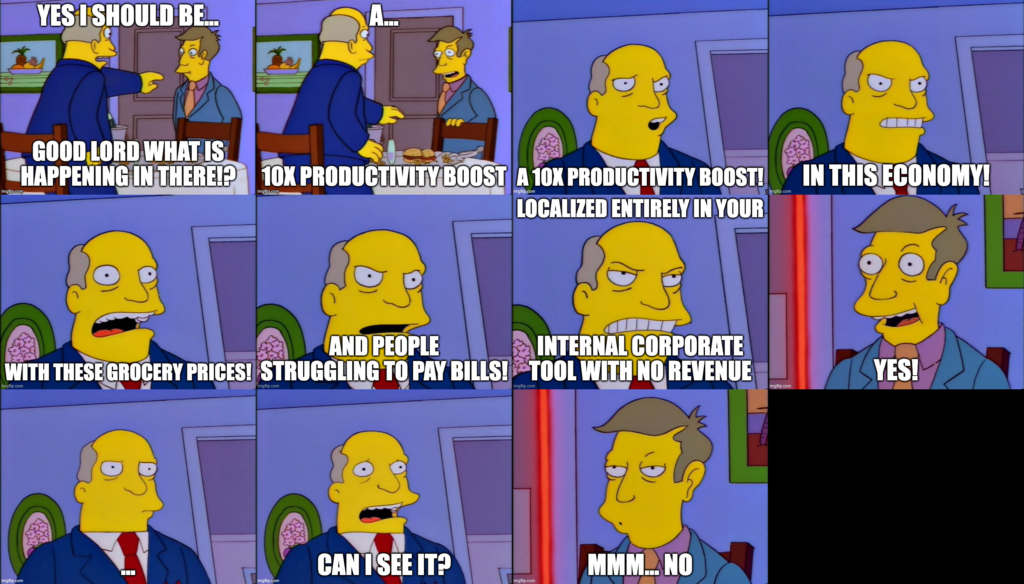
AI Boosters have been crafting a careful way to evade this conundrum, which I call Schrodinger’s Productivity:
The productivity boost from AI only exists where it cannot be observed or measured
Did it make operating systems better, or widely used apps or SaaS? No, that would be observable. But it totally means all these non-programmers can vibe code little internal tools for a company.
Where’s the Disconnect?
What we are witnessing is the producer side blabbing about how amazing AI is (to the point of becoming a meme) while the consumer side either doesn’t notice anything or is sick of having to dodge AI Slop constantly. How do we reconcile this? That is… what the producers actually measuring that makes them think they’ve unlocked a giant productivity boost?
I don’t know how this works in general, but for software specifically, the answer is quite simple, and it couldn’t be more disappointing to me:
Lines of code per unit time
I have to clarify that I am not even slightly kidding or exaggerating, but I have watched town halls with deck slides boasting that coding is dead and agentic engineering is the future of software, and justifying it with ChatGPT wrote 1 million lines of code in a day.
To reiterate… yes really.
Most of the time it is a bit more sober than this. It’s usually something more like the claim I discussed above, i.e. “AI can write 10x as many lines of code per day that a human can”.
Well, that’s not true (give me 10 minutes and I can write a script that will write as many lines of code as the development laptop can store on its hard drive, which will be at least in the billions), but even if it was, so what?
When I said this is “disappointing”, what I mean is I thought we were done with this conversation 8 years ago. I thought the software industry already successfully killed “lines of code” as a metric of value. It’s quite ironic that the same people who say “the code doesn’t matter” also think the value produced in a day can be captured by the quantity of code generated.
This is like measuring the productivity of a construction team by the number of nails they use per hour. This is not a value metric, it is a cost metric. In fact, you might as well measure the productivity of a team by how much money they spend!
The utter disconnect between productivity and AI usage led tech executives with terminal AI psychosis to redefine productivity to mean AI usage. The laziest (but most dedicated) form of this is tokenmaxxing, as in creating token usage leadership boards that literally measure employee productivity by AI tokens consumed. There were also forms at least claimed to be more sophisticated, like Shopify evaluating employees by how “creatively and efficiently” they shove a chatbot into whatever they do. Hey, that was almost a year ago, let’s check how it’s going! Oh, lol.
Most corporations have backed off of this by now, but not because the CEOs or CTOs regained any semblance of sense, it’s because the CFO finally saw the bill to Anthropic (which had switched all enterprise customers to token based billing) after the first quarter and immediately beat down the CEO/CTO’s door with a baseball bat in hand (I mean really, telling a bunch of computer programmers their bonuses will be allocated by how much they can consume an expensive web service was exceedingly foolish). They are still regularly threatening their employees with baking AI usage in one way or another into their performance evaluations.
The main point of this is that AI usage is not baked into deliverables, which was already the key performance metric… you know, the metric where you do your job? There is no correlation whatsoever with how much employees use AI and how much measurable value they actually produce for their employer. But AI executives are some of the main targets (especially by Anthropic) of a malicious “fear, uncertainty and doubt” marketing campaign tailored to make them anxious their company will fall behind if their employees don’t unlock that elusive 10x multiplier, which requires shoving a chatbot into everything, throwing every little problem at it, and trying repeatedly over and over to see if it helps with anything (very much how a casino keeps people dishing out money on the promise that eventually they’ll win a bunch back). The executives are well aware AI hasn’t done much for their company yet, and that scares them because they all mutually think all the other companies unlocked the secret and they’re the only ones trailing up the rear of the race. Some of them are even giving up on trying to “train” or push their current employees to use AI and are hiring vibe coders thinking that’s what they’re missing, that native AI talent!
The AI Hype Grift is entirely built on this “fear of missing out” (FOMO) tactic. No individual corporate leader can publicly start the conversation that leads to the grift collapsing, which would be to say, “guys, we’ve been trying to make this work and it f***ing doesn’t, what are we even doing?”, because then he would be seen as confessing that his company is incompetently losing in the “AI race”. All the other leaders, knowing full well they privately agree with it, wouldn’t be able to admit it, they’d instead say, “wow that sucks, my company is getting all sorts of huge wins!” (executives always have to say this publicly, they can’t be honest about company failures because it spooks investors and customers). It’s like the scene from Archer where Lana tells Cyril she’s going to charge every male coworker to sleep with her for revenge, but she actually meets each coworker individually, takes his money and tells him she’s not sleeping with him, but he gets to tell everyone else she did, leading to this exchange:
Furthermore, executives are not actually very happy or excited about AI. Most large companies are not doing well (maybe this doesn’t apply to the really big ones like Microsoft and Google), they’re actually up at night worrying about how to keep the business going, and they all feel like they need a miracle. AI is the miracle. The fact executives dove so hard into it is another illustration of the fact there is no productivity revolution but in fact the opposite, a growing crisis of unproductivity, that executives are praying AI is going to reverse.
This is evident from the slide decks they present internally. I have seen quite a few of these. The narrative they present for why they are “pivoting to AI” or “becoming AI first” or whatever they want to call it is not some kind of super-optimistic “guys, this is so cool, you’re gonna love this and it’s gonna shoot us to the moon!” framing, it is rather “look guys, real talk, things just aren’t working, something needs to change, we either do this new thing or we’re done for”. It’s entirely based on anxiety. They’re either afraid their entire industry is about to be replaced with chatbots wholesale (i.e. SaaSpocalypse, who’s going to buy SaaS when everyone can just vibe code it themselves now?), or they’re acutely aware their current business operations are unsustainable and on the brink of collapse and need some kind of total gamechanger. In other words, they can’t continue running their businesses at the current burn rate, which (especially for software) is mostly payroll (and in that, mostly engineer payroll), so they need a way to keep running the business without paying so many salaries.
Also, large software companies have grossly neglected routine maintenance work on their flagship products for decades, and their codebases are in an advanced state of decay and on the verge of collapse from technical debt. The nontechnical part of the organization (especially the “product” department) wants to just wish away this tech debt. They want a magic reset button that just erases it all, like the last 25 years was just a fever dream. They’ve been trying to build this magic reset button for years in the form of a “greenfield rewrite” (just start over and build a new codebase from scratch). For reasons that deserve their own articles, this never works out (these rewrites usually never go to production and just rot in internal code repos, or even worse become a new separate product to maintain). But now they think AI is that magic button finally arriving in a nice little package with a bow on their front door. Just use AI to rewrite it from scratch, in 6 months!
They don’t really care that data reveals AI isn’t the White Knight in Shining Armor they’ve been wishing for. When you’ve been wandering in the desert for 10 days and on the verge of dying from dehydration, you’re not interested in any evidence that the reflection on the horizon is just a mirage. If there’s a 1% chance it’s an oasis, well then that’s your last hope for survival. It’s either that or you’re dead, so you might as well walk in that direction. Inventing fiat productivity metrics and threatening your employees to “do AI or else” is just like the guy yelling at his legs to keep walking. The leadership level doesn’t think AI is a revolution, they need it to be a revolution and see no purpose (no upside and all downsides) to even entertaining the possibility it isn’t one.
Recession Is Revolution, Actually!
The fact corporations desperately need a revolution that’s turning out to be a plastic toy revolution is why this is going to go on until the bitter end (which likely means the financial collapse of AI vendors, or mass employee burnout that leads to a de facto economy wide strike). The latest I’ve heard is that the disconnect between what executives need AI to be capable of and what it actually is capable of is concentrating at the individual contributor level in the form of death marches, which means employees working 12-16 hour/days, 7 days/week (on salaries, so not getting a single penny extra for it) killing themselves trying to fulfill deadlines that are just comical even compared to the deadlines leaders were inventing out of thin air 4 years ago.
They’re putting up with this because they’re terrified of being fired for either not “embracing AI” (like these companies are all cults now) or for just not “holding it right” (they’re not getting the 10x boost out of it so they must be dumb and not getting it), and they keep hearing the job market is a clown show, ironically enough because both the job listing and application sides have been DDOS’d by AI Slop. Plus, people are getting laid off, so holding onto a job at all is “lucky” right now.
Guys, I don’t know, everyone being overworked with no extra pay desperately trying to keep their current job while we hear about mass layoffs, downsizing and a job market oversaturated with applicants… that doesn’t sound like a productivity revolution to me, it actually sounds like a f***ing recession! Like, to a tee. This is how people described 2008, or 1930 for that matter.
I see no more fitting way to wrap up this part of the series than by sharing how AI Boosters spin this:
Multiple simultaneous frank recession indicators are actually proof AI is revolutionary!
See, the reason why lots of people are getting laid off, people are desperate to hold the jobs they have and getting effectively much lower hourly rates due to unpaid overtime, companies are downsizing out of desperation to slash their payrolls to stay in the black, and cutting entire classes of basic services (like actual, as in “human”, customer service), is the evidence AI is a revolution!
People are getting laid off because AI is replacing them. People are desperate to hold jobs and working unsustainable hours because they’ve been genuinely obsoleted by AI and just waiting for their current employer to figure that out. Companies aren’t “downsizing”, they’re becoming more efficient! They’re not removing basic services, they’re innovating those services with cutting edge AI!
I hope this is self-evidently ridiculous to everyone reading it, but if you want a satisfactory takedown of this sophistry, I can do that. In short, this is all economically illiterate. More than anything it is an indulgence of a failure to understand the Jevons Paradox. It’s not how supply and demand works.
What does every company do when it’s doing well? It grows (this is a feature of capitalism progressives/socialists are weary of, likening it to cancer). Even if their market is fully saturated and there is no untapped demand for more units of what they sell, they are now able to keep producing those units while 90% of their current employees are totally idle. That means they can reallocate those employees to do something else: take an idea off the shelf and make it into a new product, expand to new regions, expand into an adjacent industry, etc. Why does anyone think a capitalist corporation would respond to a sudden influx of high margin profits by… firing a bunch of people!?
This is exactly the opposite of how it works. Look I’m not trying to argue that corporations are welfare programs for employees. They’re not hiring (or avoiding firing) people out of the goodness of their hearts. Ironically the whole argument of Marxism is that the owners of means of production exploit employees by acting as rent seekers, shaving off a portion of the proceeds of labor for themselves. Employees are, in this way, like quasi-slaves. Why would a slave plantation ever get rid of slaves!? If they suddenly got tractors, they wouldn’t fire slaves, they’d just get their slaves to do lots more work and pocket the extra value generated, wouldn’t they?
The rich a**holes who own large corporations either want to hoard as much wealth as possible, hoard as much power as possible by growing their corporate empires as far and wide as they can, or some combination of both. Which of these goals is served by reducing employee headcount? Employees are people whose value creation they’re skimming off the top (again I’m just taking the Marxist perspective here), so the more of these they have working for them, the more value creation they have to skim off of. Firing employees is just handing them on a silver platter to competing rich a**holes. Why would any of them want to do that?
From a “capitalist” perspective it’s not any different. They don’t think the employer-employee relationship is a zero sum parasitical one, they think it is a mutually beneficial one, where each employee is an opportunity for the employer to make more money. Even in the most cynical view of this, employers view employees as assets, like the fleet of trucks for a delivery company. Why would a company ever toss their perfectly working trucks in the garbage? If they’re going to get rid of you, they’re going to do it by completely using you up, like strip mining the value out of you. That doesn’t involve firing you while you’re perfectly capable of working, it’s more like the above-mentioned death march until you collapse from exhaustion with a permanent disability. Then they’ll drag you out and toss you in the trash. But even that is short-sighted on their part (they can’t get any more value out of you if they do that).
This idea that employees are viewed by employers as a cost is very confused. This doesn’t require us to view leaders of giant corporations as saints, or endorse “trickle down economics” or whatever. It wouldn’t be hard for a corporation to just fire all their employees. Then they don’t have a business. Even in the highly corrupt and broken financialized corporatist system we have now, corporations do the exact opposite. They actually overhire whenever they can just to show investors “look how fast we’re growing!” They will put butts in seats with nothing useful to do just so they can “show growth”. They just need the cash flow to cut the paychecks, and obviously the whole point of the company is get that cash.
Lots of us experience the unpleasant and hostile side of the employer-employee relationship, but that’s not because they’re itching to get rid of us. This is the experience of low paid, so-called “unskilled” workers, the key being they are easily replaceable. If you so much as ask for an extra bathroom break, you are now slightly more annoying to your manager than any one of the 100 applicants begging to get your job, so he’ll toss you aside and hire one of those other guys. This is exactly what layoffs or downsizes, where your position is eliminated, not refilled, are not. Yes your employer can treat you like total garbage if 100 other guys are knocking on the door eager to get your wage and put up with anything. That is literally because it is so easy to refill the job, that is, to hire someone else!
Companies are not excited to lay people off. Downsizing means the company is failing. It means they are unable to do the thing every company wants to do, which is grow like a cancer cell. What’s happening now is that a lot of companies are being forced to downsize because the economy is in a recession but they never want to be honest about this, and they see an opportunity to lie about it: call layoffs “AI innovation”. If AI was really an innovation, sure they’d relieve a bunch of their employees of their former duties, which are now AI automated, but then they’d hold onto those assets and reassign them to something else. And what would they do with the extra profit margins? Yeah, pay bigger bonuses, but that doesn’t cover much of it. Most of that extra money they’re going to reinvest in growing the company, so if anything they’d hire even more people in this scenario.
Guys, stop falling for corporate executive BS: layoffs and downsizes are failure. And there is no corporate executive on this planet who is happy to have to do it. Sure, they’re not worried about you or your family or the awkward conversation where they tell you to get lost. They’re worried about the awkward conversation with the Board and Shareholders where they have to explain why the company is shrinking. They’re deceptively spinning it as “AI innovation” because they’re that unwilling and terrified to tell the truth.
Yes there is a fantasy some executives have about AI letting them rule giant empires without having to deal with obnoxious human beings who have feelings, families, interests outside of work, health issues, and so on. But that’s a sci fi fantasy, it has nothing to do with what’s actually going on right now. What happening right now is the Western (and possibly global) economy is collapsing because it is deeply unsound (mostly due to the way money and banking works), and AI is irrelevant to that (it neither caused nor is it going to stop it).
Conclusion
It has been 3 years now, and 1 year since “coding agents” showed up. The AI Revolution not only didn’t happen, things are just getting worse. I shouldn’t even even have to say that this is incompatible with wild claims about productivity boosts. The way you destroy this narrative is to simply ask for evidence, specifically evidence from the consumer side. Where are all the amazing products? Life is no different today than 2022 except there’s a ton of low effort slop on YouTube, some obnoxious AI “assistant” you didn’t ask for bugs you on a bunch of apps or web sites, everything you actually want is more expensive, and your job is a mix of a soul sucking death march and annoying corporate leaders micromanaging your workflow to an extreme degree.
After all that, it may be surprising to hear that no one actually expected a revolution. What they did expect is what the next part is about.